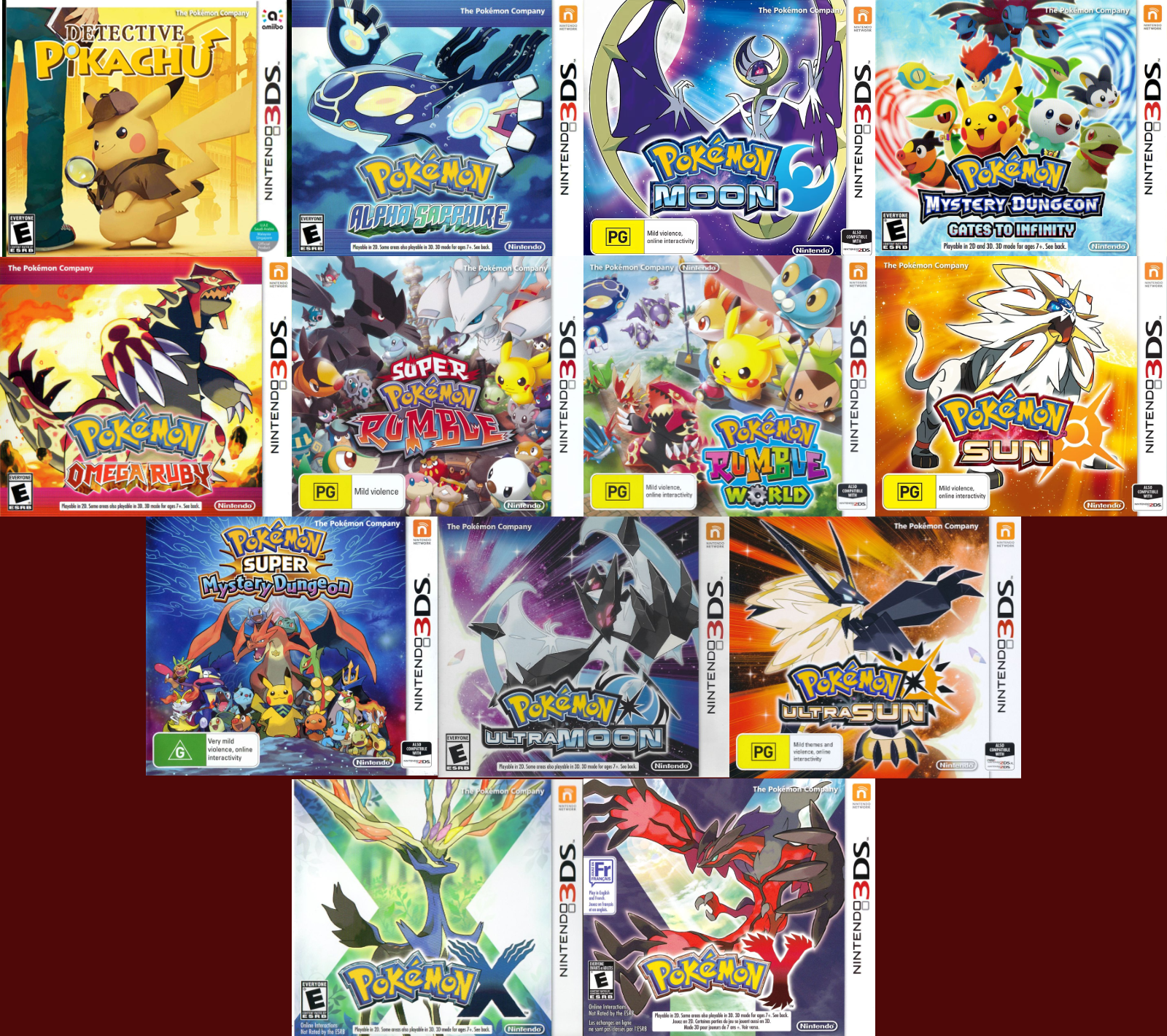
Pokémon Sun — Pokémon Sun is one of the strongest Pokémon adventures on Nintendo 3DS, taking the series to the tropical Alola region and replacing the traditional Gym structure with Island Trials. The Alola setting gives the game a distinct personality, while the introduction of regional forms adds welcome variety to familiar Pokémon. The story is more prominent than in many earlier entries, and the presentation benefits considerably from the 3DS hardware, although the frequent dialogue interruptions can make the adventure feel slower than necessary. The traditional turn-based battles remain addictive, and the enormous selection of Pokémon gives team-building plenty of depth. Despite some hand-holding and technical limitations, Sun remains an attractive and enjoyable mainline Pokémon game.
Pokémon Moon — Pokémon Moon offers essentially the same excellent Alola adventure as Sun but changes the Pokémon available, certain encounters and, most notably, the time relationship between the game world and the real world. The island environments are colorful and varied, and the regional Pokémon designs are among the more interesting additions to the series. The Island Trials provide a refreshing alternative to the traditional Gym formula, while the Totem Pokémon battles add a little extra challenge. The story is unusually character-focused for Pokémon, although the amount of dialogue and tutorials can occasionally interrupt the otherwise enjoyable exploration. It remains one of the most distinctive Pokémon games on the 3DS.
Pokémon Ultra Sun — Ultra Sun expands the original Sun formula with additional story content, new Pokémon, new areas and several substantial gameplay additions. The Ultra Recon Squad storyline and Necrozma-focused narrative give the adventure a more dramatic conclusion, while Ultra Space provides an interesting way to encounter legendary Pokémon. The expanded Pokédex and additional post-game material make it a more substantial package than the original Sun. However, much of the adventure still follows the structure of its predecessor, meaning players who recently completed Sun may find the experience too familiar. Nevertheless, its enormous amount of content and polished battle system make it arguably the definitive version of the Alola generation.
Pokémon Omega Ruby — Omega Ruby is a colorful remake of the Game Boy Advance classic Pokémon Ruby, combining the original Hoenn adventure with modern 3DS mechanics and presentation. The transition to fully 3D environments gives Hoenn a new sense of scale, while Mega Evolution and other sixth-generation mechanics significantly expand the battle system. The story remains relatively straightforward, but the enormous variety of Pokémon, Secret Bases, contests and optional activities makes the game enjoyable well beyond the main campaign. Some fans may miss certain features from the original Ruby and Emerald, and the game can be quite easy, but the improved visuals, smoother mechanics and excellent exploration make Omega Ruby one of the best Pokémon remakes.
Pokémon Alpha Sapphire — Alpha Sapphire provides the counterpart to Omega Ruby and delivers the same extensive modernization of the Hoenn adventure. Its colorful environments, expanded battle mechanics and Mega Evolutions make the old-school Pokémon formula feel considerably more modern, while the updated soundtrack works particularly well with the tropical setting. The post-game Delta Episode adds an additional storyline centered around Rayquaza and Deoxys, giving experienced players a worthwhile reason to continue after becoming Champion. Like Omega Ruby, the campaign is not particularly difficult, and some of the original game’s atmosphere is inevitably changed by the remake’s more streamlined design.
Pokémon Y — Pokémon Y represents a major technical step forward for the series, introducing fully polygonal environments and allowing battles and characters to be presented with much more visual personality. The Kalos region is attractive and varied, while the introduction of Fairy-type Pokémon, Mega Evolution and character customization gives the traditional formula several welcome additions. The story is reasonably entertaining but not particularly deep, and the main campaign is noticeably easier than many previous Pokémon games. Nevertheless, the enormous Pokédex, fast-paced battles and improved online functionality make Y a very enjoyable entry, particularly for players who appreciate competitive team-building.
Pokémon X — Pokémon X shares virtually all of Pokémon Y’s strengths and weaknesses while offering its own selection of version-exclusive Pokémon. The move into a fully 3D presentation works particularly well during battles, where animations and camera movements give the creatures considerably more personality. Mega Evolution is one of the game’s best innovations, adding another layer to team construction and allowing older Pokémon to receive powerful new forms. Kalos is pleasant to explore, although the world is somewhat less challenging than earlier Pokémon regions and the story never reaches particularly impressive dramatic heights. Even so, the combination of classic Pokémon gameplay, modern presentation and excellent multiplayer options makes X an important milestone for the series.
Pokémon Ultra Moon — Ultra Moon is the expanded counterpart to Ultra Sun, retaining the Alola setting while introducing new story material, additional Pokémon and a greatly expanded post-game. The enhanced storyline involving Necrozma provides considerably more drama than the original Moon, while Ultra Space and the ability to encounter numerous legendary Pokémon add substantial replay value. The battle system remains one of the game’s strongest elements, and the variety of available Pokémon encourages experimentation with different teams. Unfortunately, the game inherits the original’s excessive tutorials and frequent interruptions, while players who already completed Moon may find the basic adventure overly familiar. Still, as a standalone Pokémon title it is packed with content and remains one of the better 3DS entries.
Pokémon Super Mystery Dungeon — Super Mystery Dungeon successfully translates the Pokémon universe into a roguelike dungeon-crawling RPG, placing much more emphasis on exploration, combat positioning and resource management than the traditional games. The story is surprisingly ambitious, with a large cast of Pokémon and a more emotional narrative than one might expect from a spin-off. Dungeon layouts are procedurally generated, making each expedition somewhat unpredictable, while the enormous selection of playable Pokémon provides plenty of variety. Unfortunately, the repetitive nature of dungeon exploration and occasionally frustrating difficulty can wear down the experience over time. Nevertheless, it is one of the more substantial Pokémon spin-offs on 3DS and particularly appealing to players who enjoy Mystery Dungeon’s distinctive formula.
Detective Pikachu — Detective Pikachu is one of the most unusual Pokémon games on the 3DS, replacing traditional battles with a detective adventure in which a talking, coffee-loving Pikachu helps solve mysteries. The investigation structure is accessible, and the relationship between Pikachu and protagonist Tim Goodman provides much of the game’s charm. The Pokémon world is also used effectively as a setting for detective cases, giving familiar creatures unusual roles in the story. Unfortunately, the investigations are generally quite simple, with limited freedom and frequent hints making it difficult to become genuinely stuck. The presentation and voice work give it personality, but the gameplay lacks the depth expected from a traditional adventure game.
Pokémon Mystery Dungeon: Gates to Infinity — Gates to Infinity brings the Mystery Dungeon formula to the 3DS with randomly generated dungeons, turn-based exploration and a story centered around Pokémon rather than human characters. The narrative is one of its stronger elements, while the 3D presentation makes the environments more attractive than previous entries. Unfortunately, the selection of playable Pokémon is relatively limited, and the dungeon gameplay can become repetitive after extended sessions. The difficulty is also inconsistent, with some sections feeling surprisingly easy while others can punish careless play. It remains an enjoyable alternative to the main Pokémon RPGs, particularly for players who enjoy roguelike mechanics, but it lacks the breadth and refinement of the best Mystery Dungeon titles.
Pokémon Rumble Blast — Pokémon Rumble Blast turns the franchise into a fast-paced action game in which toy-like Pokémon battle enormous numbers of opponents in real-time. The controls are simple, with attacks mapped to buttons and movement allowing players to quickly dodge and overwhelm groups of enemies. Collecting defeated Pokémon provides a strong incentive to keep playing, and the sheer number of creatures gives the game considerable variety. However, the basic combat mechanics become repetitive relatively quickly, and the stages lack the strategic depth of a conventional Pokémon RPG. The colorful 3D presentation suits the series nicely, but the overall experience is better suited to short sessions than long campaigns.
Pokémon Rumble World — Rumble World expands the simple real-time combat of Rumble Blast with a much larger world, more Pokémon to collect and a progression system based around exploring different areas. The toy-like Pokémon are fun to control, and the constant possibility of finding a stronger creature gives the repetitive battles a useful sense of purpose. The colorful presentation and straightforward controls make it easy to pick up, but the combat itself remains relatively shallow, and the progression system can feel designed around encouraging repeated play rather than offering meaningful mechanical development. As a casual Pokémon action game it is entertaining, but it does not approach the depth of the main series.
————————————————————————————————————
Pokémon Sun
Brightening up the franchise with the vibrant Alola region, Pokémon Sun boldly discards traditional gym battles in favor of the engaging Island Challenge trials. Introducing powerful Z-Moves and regional forms that breathe fresh life into classic species, the game delivers an exceptionally strong, character-driven story centered around Nebby and Lillie. While the narrative focus makes for a linear, hand-holding opening hours, the immersive tropical atmosphere and streamlined gameplay mechanics make it one of the most memorable modern entries in the series.
Pokémon Moon
Pokémon Moon offers a captivating alternative to its counterpart, setting its internal clock 12 hours ahead to subvert expectations and showcase Alola’s stunning nocturnal landscapes. Sharing the same foundational shifts—such as replacing HM moves with Ride Pokémon and replacing traditional gyms with Totem Pokémon—Moon presents subtle differences in version-exclusive Pokémon and Ultra Beast encounters. Its rich narrative depth and focus on environmental storytelling make it a thoroughly charming, polished adventure for portable RPG enthusiasts.
Pokémon Ultra Sun
Serving as an enhanced definitive version of the original Alola journey, Pokémon Ultra Sun expands the story with the ominous threat of Necrozma and the mysteries of the Ultra Recon Squad. The addition of the Mantine Surf mini-game, expanded Photo Club, and the ability to travel through Ultra Wormholes to catch legendary Pokémon significantly boosts the endgame content. While it retreads much of the same ground in its first half, the expanded Pokédex, tough boss encounters, and the inclusion of Team Rainbow Rocket make it the superior choice for completionists.
Pokémon Omega Ruby
A masterclass in remake design, Pokémon Omega Ruby reimagines the beloved Gen III Hoenn region with full 3D visuals and dynamic Mega Evolutions. The addition of the DexNav makes catching Pokémon addictive by revealing hidden abilities and moves right in the overworld, while soaring through the skies on Latios adds an unmatched sense of freedom. Capped off by the gripping Delta Episode post-game narrative involving Rayquaza and Deoxys, it honors its roots while modernizing the adventure in all the right ways.
Pokémon Alpha Sapphire
Pokémon Alpha Sapphire delivers a gorgeous, nostalgic return to Hoenn with significant quality-of-life updates and stunning visual fidelity. Facing off against Team Aqua’s aquatic ambitions, players experience Primal Reversion alongside an expanded arsenal of Mega Evolutions that revitalize classic strategies. The game balances nostalgia with innovation, using the 3DS hardware to give dramatic scale to ocean navigation, Secret Base customization, and epic legendary encounters.
Pokémon Y
Pokémon Y heralded a massive technological leap for the main series, ushering in full 3D polygonal graphics, character customization, and the transformative Mega Evolution mechanic. Exploring the Kalos region—inspired by French culture and architecture—feels grand and stylish, supported by new additions like the Fairy-type to balance competitive play. Although its villainous plot with Team Flare lacks some punch and the difficulty sits on the easier side, the immense roster of catchable Pokémon makes it a joy to play.
Pokémon X
Alongside its sister version, Pokémon X brought the core franchise into the 3D era with bright visuals, dynamic battle camera angles, and the introduction of the legendary Life Pokémon, Xerneas. Features like Super Training and Pokémon-Amie allowed players to train and bond with their team like never before, while the Kalos region provided an extraordinary diversity of habitats. It stands as an accessible, high-energy entry point that fundamentally transformed the aesthetic and mechanical standards of the franchise.
Pokémon Ultra Moon
Pokémon Ultra Moon refines the 7th-generation experience into a content-packed adventure, substituting the original narrative climax with an explosive storyline focused on Necrozma’s dark forms. Featuring expanded trials, new Ultra Beasts, and an array of collectable Totem Stickers, the game offers a notably higher difficulty challenge than the original releases. The thrilling showdown against legacy villains in Team Rainbow Rocket provides a satisfying nostalgia trip that caps off the 3DS main-series era in style.
Pokémon Super Mystery Dungeon
Pokémon Super Mystery Dungeon serves as a grand culmination for the dungeon-crawling spin-off series on the 3DS, featuring all 720 Pokémon known at its release. Replacing the random recruitment system with a comprehensive Connection Orb network makes tracking and befriending new teammates far more structured and satisfying. Paired with a surprisingly emotional story, challenging tactical gameplay, and deep item management, it stands out as the definitive Mystery Dungeon title on the platform.
Detective Pikachu
Departing completely from traditional turn-based combat, Detective Pikachu is a cinematic adventure game that stars a gruff, coffee-loving Pikachu who can talk directly to his human partner, Tim Goodman. Together, they investigate crime scenes, collect clues, and interview both humans and Pokémon across Ryme City to solve a overarching mystery. Supported by expressive 3D animations and rich world-building, it delivers a charming, narrative-focused experience tailored for casual puzzle-solvers and lore enthusiasts.
Pokémon Mystery Dungeon: Gates to Infinity
Pokémon Mystery Dungeon: Gates to Infinity brought the beloved dungeon-crawler series into full 3D, introducing vibrant character models and the innovative Magnagate mechanic, which generates new dungeons using the 3DS camera. While it streamlines mechanics by reducing the overall playable roster and easing the overall difficulty compared to its predecessors, its core narrative remains warm, endearing, and packed with heart. It offers an approachable, visually pleasant entry point for newcomers to the genre.
Pokémon Rumble Blast
Pokémon Rumble Blast delivers straightforward, action-packed toy battles where players control wind-up Pokémon figures in real-time melee combat across various stages. Simple button-mashing controls allow players to mow down hordes of enemy toys, collect defeated foes to build a stronger roster, and tackle giant boss encounters. Though the gameplay loop can grow repetitive over long sessions, its fast pace and satisfying collection mechanics make it a fun beat-’em-up spin-off.
Pokémon Rumble World
Pokémon Rumble World refines the real-time toy brawler formula into a free-to-start title, allowing players to hop between hot-air balloon stages to capture over 700 Pokémon figures. Integrating Mii characters and streetpass functionality gives the toy kingdom a lively community feel, while short stage lengths make it easy to jump in for quick sessions. Despite its freemium currency mechanics, it offers a surprisingly generous amount of chaotic beat-’em-up entertainment for casual players.