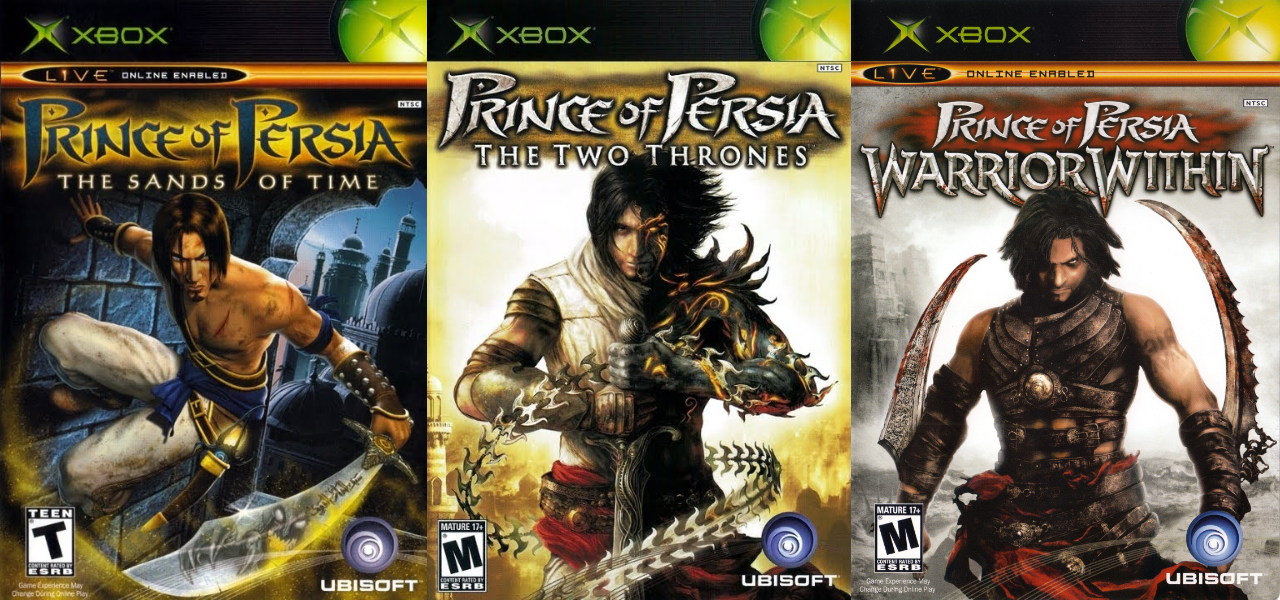
Prince of Persia: The Sands of Time (2003)
Gameplay
Prince of Persia: The Sands of Time revitalized the classic Prince of Persia formula by combining precise platforming, fluid acrobatics, and an innovative time-reversal mechanic. Players guide the Prince through an enormous Persian palace, running along walls, swinging from poles, balancing on narrow ledges, climbing columns, and solving environmental puzzles. The movement system is the game’s greatest achievement, as actions flow naturally into one another and make traversal feel like a carefully choreographed performance. The Dagger of Time allows the Prince to rewind mistakes, slow down enemies, and manipulate time during combat. This feature makes difficult platforming sequences less punishing and gives battles an additional tactical dimension. Sword fighting is relatively straightforward compared with the later games, and encounters against groups of infected palace inhabitants can become repetitive. Nevertheless, the emphasis on movement, exploration, and puzzle solving creates an excellent balance between action and adventure.
Graphics
The Sands of Time remains visually impressive for an early Xbox release. Its Persian architecture features ornate courtyards, elaborate interiors, elegant columns, decorative fountains, and sunlit stone surfaces. The environments communicate a sense of scale and beauty without relying on excessive detail, while the Prince’s animations are exceptionally fluid. Wall running, vaulting, jumping, and climbing connect smoothly, helping the character appear agile and convincing. The lighting and warm color palette reinforce the atmosphere of an enchanted palace. Although some textures and character models appear dated today, the art direction has aged gracefully, and the game’s visual identity remains distinctive.
Sound
The soundtrack blends atmospheric orchestration with Middle Eastern-inspired musical elements, creating an adventurous and occasionally mysterious mood. Sound effects are particularly effective during platforming, with footsteps, sword clashes, and the magical sounds associated with the Dagger of Time reinforcing the action. The voice acting is another highlight. The Prince narrates portions of the adventure with a conversational tone, while the dialogue between the Prince and Farah adds personality and humor to the story. Their exchanges also make the journey feel more personal than a conventional sequence of combat encounters.
Verdict
The Sands of Time is the trilogy’s most elegant and consistently focused entry. Its greatest strengths are fluid movement, ingenious puzzles, memorable atmosphere, and the innovative time-reversal mechanic. Combat is comparatively simple, but it rarely overshadows the adventure’s more creative elements. For players who value exploration, acrobatics, and carefully designed platforming, this remains the ideal starting point and arguably the trilogy’s most enduring achievement.
Prince of Persia: Warrior Within (2004)
Gameplay
Warrior Within builds upon the movement and time-manipulation mechanics of The Sands of Time while substantially expanding the combat system. The Prince can wield two weapons simultaneously, perform elaborate combinations, grab enemies, throw opponents, and use environmental objects to gain an advantage in battle. This creates a much more aggressive fighting experience, with greater emphasis on timing, weapon selection, and improvisation. The addition of secondary weapons encourages experimentation rather than relying exclusively on the Prince’s primary sword. Platforming remains an important part of the adventure, featuring wall runs, pole swings, traps, climbing sequences, and environmental puzzles. However, the Island of Time’s interconnected layout can require considerable backtracking, and revisiting areas sometimes means encountering enemies repeatedly. The Dahaka, an unstoppable supernatural pursuer, introduces tense chase sequences that contrast with the more deliberate exploration. Although the expanded combat is a welcome improvement, frequent battles can interrupt the flow of platforming, and some encounters feel unnecessarily prolonged. The overall result is a more demanding action game that sacrifices some of the original’s elegance in exchange for greater intensity.
Graphics
Warrior Within adopts a darker visual style than its predecessor, replacing much of the first game’s warm, storybook atmosphere with shadowy corridors, ruined structures, gloomy chambers, and a more brutal interpretation of ancient Persia. Character models are more detailed, the Prince has a more muscular appearance, and the combat animations emphasize the force of his attacks. The Island of Time is an atmospheric location, combining elaborate machinery, mysterious architecture, and dangerous traps with areas that change as the player moves between different periods. These environments support the game’s time-travel mechanics and give the setting a strong identity. The original Xbox version generally presents the game effectively, although the visual design can become monotonous during extended exploration because many locations share similar dark colors and architectural features. The increased emphasis on blood and violent finishing moves also makes the presentation considerably more mature than that of The Sands of Time. While technically impressive for its era, Warrior Within sometimes feels less visually varied and inviting than the original adventure.
Sound
The soundtrack is one of the most controversial changes in Warrior Within. Instead of relying primarily on the atmospheric, Middle Eastern-inspired music of The Sands of Time, the sequel introduces aggressive rock and heavy-metal influences. This approach reinforces the Prince’s darker personality and the game’s emphasis on violence, but it can feel out of place against the Persian-inspired setting. The combat sound effects are forceful, with heavy sword clashes, grunts, and finishing moves giving battles a satisfying sense of impact. Voice acting reflects the sequel’s more confrontational tone, and the Prince is noticeably more arrogant, impatient, and hostile than before. This characterization makes sense given his desperate struggle to escape his fate, although his constant taunting can become irritating. The music and sound design effectively establish a harsher atmosphere, even if they lack some of the subtlety and cohesion of the original game’s presentation.
Verdict
Warrior Within is the trilogy’s most combat-focused entry and offers the greatest emphasis on fighting techniques, weapon combinations, and brutal encounters. Its expanded combat system gives players more freedom than the original, while the Dahaka sequences and time-travel structure add tension and variety. Nevertheless, its darker atmosphere, repetitive battles, and occasional backtracking make it less consistently enjoyable as an exploration-focused adventure. Players who prefer challenging action and elaborate sword fighting may consider it the strongest installment, but those who loved the elegance and charm of The Sands of Time may find the sequel’s change in tone disappointing. It is an ambitious follow-up that improves several mechanical elements while making some divisive artistic choices.
Prince of Persia: The Two Thrones (2005)
Gameplay
The Two Thrones combines the strongest elements of its two predecessors, restoring much of The Sands of Time’s emphasis on fluid platforming while retaining Warrior Within’s expanded combat system. The Prince returns to Babylon, only to discover that his actions have dramatically altered the course of events. Players navigate rooftops, palace interiors, underground passages, and war-torn streets using wall running, swinging, climbing, jumping, and elaborate environmental maneuvers. The level design encourages continuous movement, and the traversal sequences make several sections particularly enjoyable. Combat remains based on combinations, secondary weapons, and environmental opportunities, but the major addition is the speed-kill system. By approaching enemies stealthily and executing attacks with carefully timed button presses, players can eliminate opponents before triggering a conventional fight. These encounters reward observation and precision while reducing the number of prolonged battles that sometimes burdened Warrior Within. The Dark Prince provides another significant variation, replacing conventional weapon use with a deadly chain and introducing a more aggressive fighting style. However, this transformation comes with a health-draining mechanic that forces players to keep moving and collect sand resources. The balance between stealth, platforming, and combat makes The Two Thrones a more varied experience than its predecessor, although some stealth sequences can be unforgiving and the game occasionally relies on familiar encounters.
Graphics
The Two Thrones returns to a brighter and more colorful visual presentation, combining the first game’s fairy-tale atmosphere with the sequel’s more detailed character models and combat animations. Babylon is an especially effective setting, featuring towering buildings, bustling rooftops, elaborate palaces, burning streets, and impressive views across the city. The contrast between peaceful architectural details and the destruction caused by the invasion gives the environment a stronger narrative purpose. The Prince’s animations remain a major technical highlight, particularly during wall running, aerial attacks, stealth kills, and acrobatic transitions. The Dark Prince’s appearance also provides a visual contrast, with his darker features and distinctive chain weapon reinforcing the character’s threatening nature. Although the underlying graphics technology is similar to that of the previous games, the lighting, atmospheric effects, and environmental variety make the presentation feel fresh. Some textures and character models show their age, but the original Xbox version remains visually impressive for a game released in 2005.
Sound
The soundtrack moves away from Warrior Within’s heavy-metal influences and returns to a more traditional Middle Eastern-inspired musical style. This change helps restore the exotic, adventurous atmosphere that defined The Sands of Time, while the music shifts appropriately between exploration, combat, and dramatic story sequences. Sound effects are effective throughout the game, from the Prince’s footsteps and weapon clashes to the distinctive sounds accompanying the Dark Prince’s chain attacks. Voice acting is another strength, with the Prince’s personality becoming more balanced after the hostility of the previous installment. His internal conversations with the Dark Prince add psychological tension and provide an interesting way to explore the consequences of his actions. The dialogue between characters also helps connect the story to the events of the earlier games. Although the soundtrack does not always deliver the same memorable melodies as the original, the overall sound design is more cohesive than Warrior Within’s.
Verdict
The Two Thrones is a satisfying conclusion to the original Xbox trilogy because it combines the first game’s fluid traversal and atmosphere with the second game’s more sophisticated combat. The speed-kill mechanic adds tactical variety, Babylon provides an impressive setting, and the Dark Prince introduces an entertaining alternative to the standard gameplay. It does not quite recapture the novelty of The Sands of Time, and some sequences can feel less polished than their concepts suggest, but it delivers a strong combination of action, puzzles, stealth, and storytelling. For players seeking the most balanced entry in the trilogy, The Two Thrones is arguably the best overall package.
Overall Comparison
Gameplay: The Sands of Time is the most focused on platforming and environmental puzzles. Warrior Within places the greatest emphasis on direct combat and weapon combinations. The Two Thrones offers the most varied mix, thanks to stealth kills, refined fighting, and the Dark Prince.
Graphics: The Sands of Time has the most distinctive storybook atmosphere, Warrior Within features a darker and more violent visual style, and The Two Thrones delivers the strongest combination of environmental detail, color, and animation.
Sound: The Sands of Time has the most cohesive atmospheric soundtrack and charming dialogue. Warrior Within is the most aggressive and divisive in its musical direction. The Two Thrones restores the series’ Middle Eastern-inspired sound while retaining more mature storytelling.
Story and Atmosphere: The Sands of Time tells the most intimate and charming adventure. Warrior Within explores desperation, fate, and the consequences of the Prince’s actions. The Two Thrones brings the overarching story together while examining the Prince’s struggle with his darker side.
Replay Value: All three games benefit from their time-manipulation mechanics and unlockable content. Warrior Within offers a particularly demanding combat experience, while The Two Thrones rewards players who want to master stealth kills and explore its environments efficiently.
Final Verdict
Prince of Persia: The Sands of Time is the best overall adventure, offering the most cohesive combination of platforming, puzzles, storytelling, atmosphere, and innovative mechanics. Prince of Persia: Warrior Within is the strongest choice for players who prioritize challenging combat, elaborate fighting techniques, and a darker atmosphere. Prince of Persia: The Two Thrones provides the best balance of acrobatics, puzzles, stealth, and combat, making it the most varied entry in the trilogy. All three games are worth owning for an original Xbox collection, and playing them in release order is the best way to appreciate the evolution of the gameplay and the Prince’s character. If choosing only one, The Sands of Time is ideal for the classic experience, while The Two Thrones offers the broadest variety of gameplay.
——————————————————————————————
The original Xbox trilogy of the Prince of Persia franchise—”Prince of Persia: The Sands of Time”, “Prince of Persia: Warrior Within”, and “Prince of Persia: The Two Thrones”—represents one of the most defining 3D action-adventure arcs of the sixth console generation. Across all three titles, the original Xbox hardware served as the definitive console platform, running at a crisp 480p output with stable framerates, superior lighting effects, and fast loading times compared to its contemporary console counterparts.
Below is a detailed comparative review of all three games, broken down by gameplay, graphics, sound, and final verdicts.
Prince of Persia: The Sands of Time (2003)
Gameplay
“The Sands of Time” revolutionized the 3D platforming genre by introducing wall-running, pole-swinging, ledge-hanging, and trap navigation, all connected with fluid momentum. Its core mechanic, the Dagger of Time, allows players to rewind time to fix mistakes, slow down time during platforming or combat, and freeze enemies. Platforming is structured as intricate environmental spatial puzzles. Combat is lighter than in subsequent entries, focusing on vaulting over sand creatures and absorbing their essence with the Dagger. While fighting can feel repetitive in the latter half due to long waves of enemies, the seamless platforming and rewind mechanics keep the pacing fast and engaging.
Graphics
The visual style is warm, vibrant, and fairy-tale-like, heavily inspired by classical Middle Eastern aesthetics. The original Xbox version showcases detailed architectural structures, soft bloom lighting, shimmering sand effects, and realistic cloth physics. The character animation was industry-leading for its time, featuring seamless transitions between jumps, swings, and combat slashes.
Sound
Featuring an Arabian-inspired orchestral soundtrack blended with light ambient soundscapes, the music creates a sense of wonder and urgency. Voice acting is superb, with Yuri Lowenthal providing a charming, reflective internal monologue for the Prince, complemented by excellent dialogue exchanges with Farah. Sound effects, from the swoosh of wall-runs to the mystical chime of rewinding time, are crisp and effective.
Verdict
“The Sands of Time” is a timeless masterpiece of environmental game design, narrative delivery, and innovation. It remains the most balanced and poetic entry in the trilogy.
Prince of Persia: Warrior Within (2004)
Gameplay
“Warrior Within” completely overhauls the series by shifting focus toward a deep, visceral combat system called Free-Form Fighting. The Prince can dual-wield weapons, perform acrobatic throws, execute decapitations, and use enemies as human shields. Platforming remains tight and adds new elements like sliding down wall banners with a dagger and fleeing from the relentless Dahaka in high-speed pursuit sequences. The game introduces an interconnected, Metroidvania-style island castle where players switch between past and present timelines to alter environmental layouts. However, the heavy emphasis on combat and frequent backtracking split fan opinions compared to the linear elegance of the first game.
Graphics
The visual direction shifts dramatically from bright palaces to a dark, industrial, gothic aesthetic filled with blood, rust, and jagged architecture. On the Xbox, technical polish is high, with dense geometric environments, improved texture clarity, and advanced shadow rendering. Character models are sharper, though the darker lighting palette trades away the whimsical charm of the original.
Sound
The sound design takes an aggressive turn, replacing traditional Middle Eastern orchestration with heavy metal guitar riffs (featuring music by Godsmack and composer Stuart Chatwood) during combat sequences. Voice actor Robin Atkin Downes takes over as the Prince, giving him a grizzled, angry tone fitting his hunted persona. Sound effects are far punchier, emphasizing harsh blade clashes, fleshy strikes, and the booming roars of the Dahaka.
Verdict
While its mid-2000s angst and heavy metal soundtrack can feel jarring in hindsight, “Warrior Within” is mechanically superior in combat and offers a longer, more challenging adventure.
Prince of Persia: The Two Thrones (2005)
Gameplay
“The Two Thrones” serves as a middle ground between the fairy-tale tone of “The Sands of Time” and the dark combat of “Warrior Within”. It retains the Free-Form Fighting system while introducing the Speed Kill mechanic—context-sensitive stealth assassinations that allow players to eliminate entire groups of enemies silently without initiating full battles. The core gimmick features dual gameplay states: controlling the standard Prince and turning into the Dark Prince. The Dark Prince constantly loses health over time (replenished by sand) and uses a whip-like Dagger Tail for grappling, pulling objects, and executing mid-air combat sweeps. Chariot racing sequences are also added to break up the platforming and combat.
Graphics
Set in the burning, war-torn streets and rooftops of Babylon, the visual style returns to an authentic Persian palette while retaining a gritty war backdrop. The Xbox version delivers clean draw distances across vast cityscapes, impressive flame and smoke particle effects, and impressive animation work for the Dark Prince’s Dagger Tail.
Sound
Yuri Lowenthal returns as the Prince, delivering a performance that captures his growth, while Rick Miller voices the Dark Prince, serving as a bitter, cynical inner voice that constantly taunts him. The musical score drops the heavy metal in favor of a hybrid soundtrack, mixing cinematic Middle Eastern melodies with high-energy percussion. Environmental audio and weapon impacts are balanced and well-integrated.
Verdict
“The Two Thrones” brings the Sands of Time trilogy to a satisfying conclusion. By refining combat through stealth and re-establishing emotional depth, it delivers a well-rounded action-adventure experience.
Comparative Summary
Gameplay Evolution
“The Sands of Time” presents pure, puzzle-focused platforming paired with simple, defensive combat. “Warrior Within” shifts the focus toward complex combat combos, dual-wielding, and nonlinear castle exploration. “The Two Thrones” synthesizes both approaches by adding stealth kills, distinct Dark Prince mechanics, and linear city traversal.
Visual Direction
The series moves from bright Arabian romance in “The Sands of Time”, to gothic, metal-inspired darkness in “Warrior Within”, and finally to a fiery, atmospheric war setting in Babylon with “The Two Thrones”.
Soundtrack & Voice Acting
“The Sands of Time” provides a peaceful, mystical score and charming character acting. “Warrior Within” relies on heavy metal and an aggressive tone. “The Two Thrones” restores orchestral arrangements while using a dual-voice narrative dynamic between the Prince’s light and dark halves.
Trilogy Legacy
“The Sands of Time” stands out for its artistic purity and narrative impact. “Warrior Within” delivers the most technical and challenging combat mechanics. “The Two Thrones” successfully ties together the narrative and mechanics of both predecessors into a cohesive finale.
——————————————————————————————-
Prince of Persia: The Sands of Time Trilogy – Xbox Original Review
The Sands of Time Trilogy on the original Xbox is one of the best trilogies of that generation. All three games were built on the same core engine – acrobatic platforming, time manipulation, and cinematic combat – but each one takes it in a very different direction. On Xbox, all three run at 480p, with a much more stable frame rate than the PS2 versions and slightly cleaner textures thanks to the hardware.
1. GAMEPLAY
The Sands of Time (2003):
This is the purest and most focused game of the three. Gameplay is built around traversal. Prince is light, acrobatic, and precise. You run on walls, swing from bars, climb pillars, and jump between columns. The level design is like a giant puzzle box – the Palace of Azad is one interconnected playground.
Combat is simple and intentional. You have one sword, and you fight 2-4 enemies at a time. It’s not about combos, it’s about positioning. You vault over enemies, slash, and then you have to finish them with the Dagger of Time to prevent them from resurrecting from the sand.
The core mechanic is time control. You collect Sand and you can Rewind (undo a mistake or death), Slow, Freeze, and see visions. Rewind alone makes the platforming incredibly forgiving and fluid. It is the most elegant system of the trilogy and it never gets bloated.
Warrior Within (2004):
This is a complete tonal and mechanical shift. Ubisoft Montreal responded to criticism that Sands of Time was too easy and too childish, so they made it darker, heavier, and much more combat-focused.
Platforming is still there, but level design is now a Metroidvania-style interconnected Island of Time. You constantly backtrack with new time powers to open new paths. It has more exploration but less of that perfect linear flow.
Combat is completely overhauled. You now have a free-form fighting system. You can pick up a second weapon in your off-hand, you can throw enemies, slash with two swords, steal weapons, and chain combos. There are dozens of weapons, each with different speed and damage, that break over time. Boss fights are much harder and more frequent. It’s deeper, but also messier – the camera on Xbox struggles in tight corridors when you are surrounded by 6 enemies.
Time powers are now offensive. Ravages of Time, Eye of the Storm, Wind of Fate – you slow time and do massive damage. Rewind is still there but costs more Sand, making the game more punishing.
The Two Thrones (2005):
This is the synthesis. It tries to take the best of both games and fix the mistakes of Warrior Within.
It brings back the linear, palace-focused level design of Sands of Time, but keeps the expanded combat of Warrior Within. You get the Speed Kill system – a stealth instant-kill mechanic where you have to time button presses to assassinate enemies silently. This adds tension and variety.
It also introduces the Dark Prince. After being infected by the Sands, you transform. As the Dark Prince, you cannot rewind with the dagger, you have a chain whip called the Daggertail, you constantly lose health and must collect sand to survive. It forces a much more aggressive, forward-moving playstyle.
The chariot sequences are new and divisive. You race through streets while avoiding obstacles. On Xbox they control okay, but they are trial-and-error heavy.
In terms of pure gameplay flow: Sands of Time is the smoothest and most elegant, Warrior Within is the deepest and hardest, Two Thrones is the most varied but slightly uneven.
2. GRAPHICS
All three games run on Ubisoft’s Jade engine. On Xbox Original, they have an advantage over PS2: less fog, sharper textures, and they hold close to 30fps with fewer drops.
The Sands of Time: Still beautiful today because of art direction, not tech. It’s bright, dreamlike, with warm golds, blues, and soft lighting. The palace looks magical. Character models are low-poly by today’s standards, but the animation is exceptional – Prince’s movements were rotoscoped and it shows. Particle effects for sand are great for the time. The weakness is some very empty rooms and low-res textures on distant walls.
Warrior Within: The darkest game visually. The palette shifts to blacks, reds, greys, and browns. The Island of Time is gothic, industrial, and bloody. Prince is bulkier, wearing armor and with a much grittier face. Technically it pushes the engine much harder – bigger areas, more enemies on screen, more effects. On Xbox this means more frame drops than Sands of Time, especially in the large central hall. But the lighting is more dramatic and the enemy designs (Grinders, Raiders, Silhouette monsters) are much more creative.
The Two Thrones: The best looking of the three on Xbox. It returns to the bright Babylon setting but keeps the detail level of Warrior Within. Babylon is dense, vertical, and alive – you see citizens, marketplaces, and huge draw distances that the previous games didn’t have. The Prince model is the best of the trilogy, and the Dark Prince transformation with glowing veins and ash is excellent. It has the least screen-tear and the most stable performance on Xbox of the three late-era titles. The only downside is some asset reuse from the first two games.
3. SOUND
The Sands of Time: The soundtrack is iconic. Composed by Stuart Chatwood, it’s a mix of Arabian percussion, ambient strings, and subtle electronica. It adapts to gameplay – quiet when exploring, intense when fighting. Voice acting is superb. Yuri Lowenthal as The Prince is charming, cocky, and vulnerable. The narration by the Prince telling the story to Farah, who constantly interrupts and comments, is brilliant storytelling. Farah herself is well-acted and actually useful – she shoots arrows to help you. Sound effects for the Dagger are crisp and satisfying.
Warrior Within: A total 180. The soundtrack features Godsmack and Stuart Chatwood doing heavy metal guitar riffs. In combat it fits the aggressive tone, but during platforming it feels completely out of place. The atmosphere suffers because of it. Voice acting: Prince is now voiced by Robin Atkin Downes with a gravelly, angry Batman voice. He sounds older and more bitter, which fits the story but loses all the charm. Kaileena and the Empress are well-voiced. The Dahaka chase sequences have amazing sound design – that terrifying sound effect and booming footsteps still create dread.
The Two Thrones: A return to form. Chatwood brings back the Arabian themes from the first game but adds darker undertones for the Dark Prince. The two voices in Prince’s head – Lowenthal returns as the normal Prince, and Rick Miller as the Dark Prince mocking him – is fantastic. It creates great internal conflict. Farah returns, though she doesn’t remember you. The soundtrack balances both styles – orchestral for exploration, heavier drums for combat. Overall it’s the most balanced audio mix.
4. VERDICT
If you only play one on original Xbox, make it The Sands of Time. It has aged the best because its design is so tight and focused. It’s a 9/10 game that invented a genre. Short (8-10 hours), no filler, every puzzle and fight matters. It’s the most charming and creative.
Warrior Within is the cult favorite. If you want challenge, deep combat, and a darker, more mature atmosphere, this is your game. It’s ambitious and flawed – 8/10. The combat is fun but the backtracking, edgy tone, and metal soundtrack alienated a lot of fans. It’s also the hardest by far and some platforming sections are brutally punishing because Rewind is limited.
The Two Thrones is the fan-service finale. It corrects the course, gives you the best combat, two playstyles, and a satisfying end to the story. It’s an 8.5/10. It doesn’t reach the elegant perfection of the first game, but it’s more fun moment-to-moment than Warrior Within and has the best presentation on Xbox.
Final Ranking for Xbox Original:
For Best Overall Experience: The Sands of Time
For Best Combat and Challenge: Warrior Within
For Best All-Rounder and Graphics: The Two Thrones
Played in order, the trilogy is one of the greatest character arcs in action-adventure games – you watch a cocky prince become a haunted killer and then finally learn responsibility. On original Xbox hardware, they are still very playable today, especially if you have component cables.
——————————————————————————————
Prince of Persia Trilogy on Xbox: A Comparative Retrospective
The Prince of Persia Sands of Time trilogy represents one of the most fascinating case studies in early 2000s game development. Across three years and three titles, Ubisoft Montreal created a beloved classic, alienated much of its audience with a drastic tonal shift, and then attempted to reconcile both directions in a final chapter that satisfied few as completely as the original had. This review examines all three Xbox titles across gameplay, graphics, and sound, culminating in a verdict for each.
Prince of Persia: The Sands of Time
Gameplay
The Sands of Time introduced a revolutionary approach to 3D platforming that prioritized fluidity and forgiveness over punishing precision. The Prince moves with an almost balletic grace, chaining wall runs, column swings, and long jumps into continuous sequences that feel more like choreography than input commands. The game’s signature mechanic, the Dagger of Time, allows players to rewind mistakes, slow combat, and freeze enemies. This single innovation transformed the trial-and-error frustration common to 3D platformers into an empowering experience where death became a learning tool rather than a punishment.
Combat, however, is the weakest link. The system is rudimentary by comparison to what would follow, with a simple combo string and a finisher move using the dagger. Critics noted that the fighting leaves just a little to be desired, and many encounters devolve into repetitive wall-dash attacks followed by a stab. The camera, while generally competent, occasionally struggles during tight platforming sections, though it remains far more reliable than its sequel’s. The game runs approximately ten to fifteen hours, a substantial length for the era.
Graphics
For its time, The Sands of Time was a visual marvel. The game’s art direction embraced a storybook Persian aesthetic, with sun-drenched palaces, intricate tilework, and a color palette that felt warm and inviting. The Prince’s animation work remains exceptional even by modern standards, with transitions between acrobatic moves occurring seamlessly. Character models, particularly Farah, the Prince’s companion, display surprising expressiveness and detail. The environments are varied and imaginative, though the game’s linear structure means they are traversed in a mostly straightforward manner. Critics at the time described the visuals as gorgeous and stunning, and the game’s aesthetic cohesion is arguably its greatest enduring strength.
Sound
The soundtrack by Stuart Chatwood is a masterwork of atmospheric composition. Drawing heavily on Middle Eastern instrumentation and melodies, the score shifts dynamically between exploration themes that are contemplative and combat tracks that are urgent without becoming intrusive. The voice acting, particularly Yuri Lowenthal as the Prince and Joanna Wasick as Farah, brings genuine warmth and humor to the script. The Prince’s internal monologue, delivered with a storyteller’s cadence, frames the entire adventure as a tale being recounted, a narrative device that adds considerable charm. Some users found the ambient soundtrack during exploration too quiet, but this restraint allows the environmental sounds and music cues to land with greater impact.
Verdict
The Sands of Time is a landmark achievement in action-adventure design. Its platforming remains exceptionally fluid, the time manipulation mechanic is brilliantly integrated into both puzzle-solving and combat, and the presentation holds up as one of the most aesthetically cohesive games of its generation. Combat is shallow and repetitive, but it occupies a smaller portion of the experience than in its sequels. This is the most essential title in the trilogy and one of the finest games available on the original Xbox.
Prince of Persia: Warrior Within
Gameplay
Warrior Within dramatically expands the combat system, introducing a dual-wielding mechanic that allows the Prince to pick up secondary weapons from defeated enemies. The free-form fighting system enables context-sensitive environmental attacks, allowing the Prince to swing from poles, bounce off walls, and perform elaborate combos with far more depth than its predecessor. The addition of new time powers, including a berserker rage and a destructive shockwave, provides tactical variety.
However, this expanded combat comes at the expense of the platforming that defined the first game. While acrobatic traversal remains present, it occupies a smaller proportion of playtime, and the puzzle design suffers from the game’s central mechanic of traveling between the past and present versions of the Island of Time. This creates extensive backtracking through the same environments in two different states, a design choice that many critics found tedious. The camera, notoriously, positions itself in cinematic angles that frequently obstruct the player’s view of jumps and landings, leading to numerous deaths that feel unfair rather than instructive. The Dahaka chase sequences, while conceptually thrilling, often devolve into frustrating trial-and-error due to these camera issues.
Graphics
Warrior Within trades the sunlit warmth of its predecessor for a grim, desaturated palette of grays, browns, and blacks. The Prince himself has transformed from a youthful adventurer into a scowling, muscular warrior, a design shift that reflects the game’s mature aspirations. The environments are larger and more complex, but the visual identity feels generic by comparison. Critics noted that while the game is technically impressive, with detailed textures and atmospheric lighting, the oppressive darkness becomes monotonous over time. The cutscenes, meanwhile, are plagued by low-poly character models that look worse than the previous game’s, with facial animations that struggle to convey the emotional weight the script demands. The babe factor also increases significantly, with female characters designed and framed in ways that critics described as puerile and juvenile.
Sound
The most controversial aspect of Warrior Within is its soundtrack. Stuart Chatwood’s Middle Eastern compositions are largely replaced by heavy rock guitar riffs, a decision intended to match the Prince’s new edgy persona but which alienated much of the existing fanbase. The result feels incongruous with the Persian setting, as if a heavy metal album were playing over a historical epic. Voice acting also takes a hit. The Prince, voiced by Robin Atkin Downes in this installment, delivers a raspy, perpetually angry performance that strips the character of his wit and charm. Additionally, the Xbox version specifically suffered from audio glitches where background music would abruptly cut out during gameplay, a technical issue that further diminished the experience.
Verdict
Warrior Within is the black sheep of the trilogy, and not without reason. Its combat system is genuinely improved and remains satisfying for those who engage with its depths, but the game sacrifices too much of what made its predecessor special. The platforming is compromised by camera problems, the backtracking is excessive, and the tonal shift from charming adventure to grimdark revenge story feels forced and calculated rather than organic. It remains playable and has its defenders, particularly those who appreciate the expanded combat and the tragic, time-loop narrative, but it is a deeply divisive entry that alienated a significant portion of the audience the first game had won.
Prince of Persia: The Two Thrones
Gameplay
The Two Thrones attempts to synthesize the best elements of its two predecessors. The platforming returns to prominence, with more environmental puzzles and acrobatic sequences than Warrior Within offered, though many critics found these sections simpler and less demanding than those in The Sands of Time. The combat system retains Warrior Within’s dual-wielding and environmental attacks but adds the Speed Kill mechanic, a stealth-based instant execution that rewards patience and positioning. When the Prince sneaks up on an unaware enemy, a brief quick-time sequence allows for a swift, stylish kill. This mechanic adds a welcome tactical layer to combat encounters, though its execution can be finicky.
The game’s most significant gameplay addition is the Dark Prince, an alter ego who emerges when the Prince becomes infected by the Sands of Time. Playing as the Dark Prince introduces a chain-whip weapon with extended reach and unique traversal abilities, but his health constantly depletes and must be replenished by defeating enemies. This creates urgency but also frustration, particularly in sections where enemies are sparse or the path forward is unclear. The chariot racing sequences, while visually impressive, control poorly and feel out of place. The game is notably shorter than its predecessors, clocking in at around seven hours.
Graphics
The Two Thrones returns to the brighter, more vibrant aesthetic of The Sands of Time, replacing Warrior Within’s monochromatic gloom with the golden sands and colorful architecture of a besieged Babylon. The art design is genuinely impressive, with curtains swaying in the breeze, sand particles clinging to the Prince’s body, and grand vistas that convey the scale of the fallen city. However, the character models and cutscenes retain the rough, pixelated quality of Warrior Within, with facial animations that remain unsettling rather than expressive. The Dark Prince transformation features some striking visual effects, but overall the game’s technical presentation feels like a step backward from the first game’s cohesion, even as its art direction recovers somewhat.
Sound
The Middle Eastern-inspired score returns, much to the relief of fans who rejected Warrior Within’s rock soundtrack. Stuart Chatwood’s compositions once again evoke the Persian setting with appropriate instrumentation and melody, and the return of Yuri Lowenthal as the Prince’s voice brings back the character’s charm and wit. The Dark Prince, voiced with a more sinister cadence, provides effective contrast. The dialogue occasionally leans into melodrama, particularly in the game’s more emotional scenes, but the overall audio presentation is a significant improvement over Warrior Within. The Xbox version still exhibits some of the sound mixing issues present in the previous game, though they are less pronounced.
Verdict
The Two Thrones is a well-intentioned course correction that ultimately falls short of its ambitions. It successfully restores the visual and musical identity of the first game while retaining the improved combat of the second, and the Speed Kill mechanic is a welcome addition. However, the level design is too linear, the puzzles are too simple, and the Dark Prince sections introduce a survival-horror tension that clashes with the power fantasy the rest of the game provides. It is a satisfying conclusion to the trilogy’s story, with an emotionally resonant ending that brings the Prince’s journey to a meaningful close, but as a game it sits comfortably between its two predecessors in quality without surpassing either.
Final Thoughts
The Prince of Persia Sands of Time trilogy on Xbox represents a trilogy of distinct design philosophies rather than a unified vision. The Sands of Time remains the essential entry, a game whose platforming, time mechanics, and presentation coalesce into something genuinely special. Warrior Within is a fascinating failure, an attempt to chase a trendier audience that succeeded in expanding combat but lost the series’ soul in the process. The Two Thrones is a respectable compromise that satisfies without excelling, bringing the story to a fitting conclusion while failing to recapture the magic of the original. For those experiencing the trilogy for the first time, The Sands of Time stands alone as a classic. The sequels are worthwhile primarily for their narrative continuity and for players who find themselves deeply invested in the Prince’s journey.