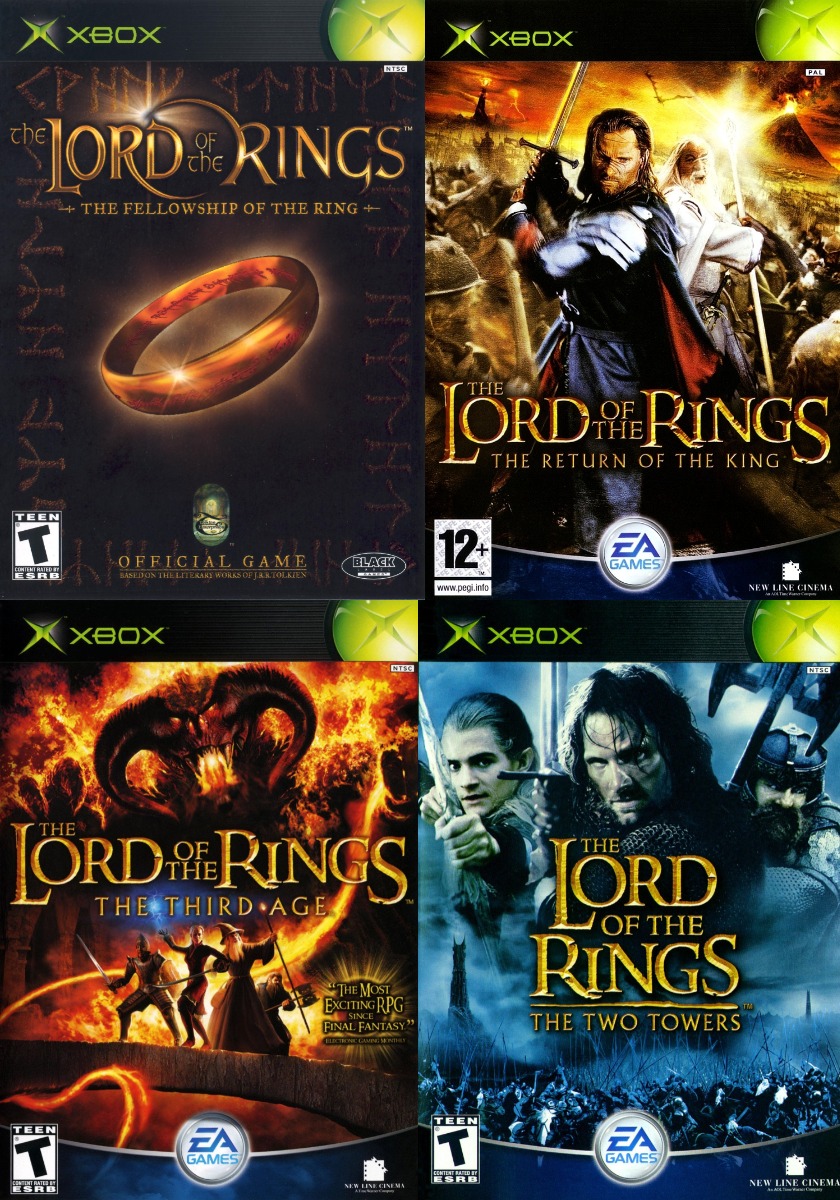
The four original Xbox games based on The Lord of the Rings offer different ways to experience Middle-earth. The Fellowship of the Ring emphasizes exploration and adventure, The Two Towers and The Return of the King focus on cinematic hack-and-slash combat, while The Third Age takes a turn-based RPG approach. Their strengths and weaknesses differ considerably in gameplay, presentation, and how effectively they recreate Tolkien’s fantasy world.
The Lord of the Rings: The Fellowship of the Ring
Gameplay
The Lord of the Rings: The Fellowship of the Ring takes a different approach from the more combat-oriented adaptations of Tolkien’s fantasy world. Rather than concentrating primarily on spectacular battles, the game combines exploration, action, stealth, puzzle solving, and item collection in an adventure inspired more directly by the original novel. Players primarily control Frodo, whose journey takes him from the peaceful Shire toward increasingly dangerous locations across Middle-earth. Aragorn and Gandalf also become playable characters, each bringing different abilities and approaches to encounters. Frodo relies on stealth and evasive movement to avoid powerful enemies, while Aragorn is better suited to direct combat and Gandalf possesses magical abilities. This variety gives the adventure more breadth than a conventional action game, although the individual mechanics are not always equally successful. Exploration often involves finding objects, activating mechanisms, completing straightforward objectives, and navigating environments populated by hostile creatures. Unfortunately, the mission design can become repetitive, and some objectives require considerable backtracking without offering particularly interesting puzzles. Combat is less polished than in the later film-based games, with awkward encounters and occasionally frustrating controls undermining the experience. Nevertheless, the adventure has its own identity, particularly for players interested in locations and events that received less attention in the cinematic adaptations.
Graphics
The Fellowship of the Ring offers a recognizable interpretation of Middle-earth, with environments inspired by the Shire, forests, ancient ruins, and the Mines of Moria. The contrast between peaceful rural landscapes and threatening underground locations helps establish the journey’s progression from innocence to danger. Character models are reasonably detailed for an early Xbox release, and some of the larger enemies are impressive in scale and appearance. Environmental design is generally more successful than the animation, with forests, caves, and ruined structures providing a convincing fantasy atmosphere. However, the presentation is inconsistent. Certain areas appear relatively plain, character movements can look stiff, and environmental details sometimes lack polish. The camera can also make navigation and combat more difficult than necessary. Although the game occasionally captures the scale and mystery of Tolkien’s world, it lacks the cinematic visual consistency of the later action adaptations. Its slower pace and more exploratory design nevertheless allow players to spend time in locations that are not simply backdrops for large battles.
Sound
The soundtrack is one of the game’s more effective elements, using atmospheric music to distinguish peaceful areas from dangerous encounters. The musical arrangements create an appropriate sense of mystery during exploration and tension when enemies approach. Environmental sound effects also contribute to the atmosphere, particularly in forests, caves, and other isolated locations. Voice acting helps communicate the story, although the dialogue and character performances are not always as compelling as they could be. The game draws on Tolkien’s established narrative but does not consistently convey the emotional weight of the original story. Some conversations feel functional rather than dramatic, and the sound presentation occasionally lacks the polish of a major cinematic production. Even so, the music and environmental audio help maintain a recognizable sense of Middle-earth throughout the adventure.
Verdict
The Lord of the Rings: The Fellowship of the Ring is an interesting alternative to the more familiar action games based on the film trilogy. Its combination of exploration, stealth, puzzles, and multiple playable characters gives it a broader adventure structure, and its closer connection to the novel provides a different perspective on the journey. However, repetitive objectives, inconsistent combat, awkward controls, and uneven presentation prevent it from reaching the standard set by its successors. It is best suited to dedicated Tolkien fans who want to explore a different interpretation of Middle-earth rather than players seeking a polished action game. Despite its shortcomings, it remains a distinctive entry in the original Xbox’s collection of fantasy adventures.
The Lord of the Rings: The Two Towers
Gameplay
The Lord of the Rings: The Two Towers shifts the emphasis toward fast-paced third-person combat, delivering an action-oriented interpretation of the battles and adventures depicted in the first two films. Players control Aragorn, Legolas, and Gimli across a series of missions inspired by major events in the story. Each character has a distinct fighting style. Aragorn combines sword attacks with balanced defensive abilities, Legolas specializes in ranged combat with his bow, and Gimli relies on powerful melee attacks that can overwhelm groups of enemies. The combat system features quick and heavy attacks, blocking, combinations, and character progression. As players defeat opponents, they earn experience that can be used to unlock additional moves and improve their characters. This creates a satisfying sense of development as the adventure progresses. The combat is straightforward to learn but offers enough variety to make battles enjoyable, especially when facing large groups of orcs and other enemies. The level design combines linear routes with occasional opportunities to explore the battlefield, while objectives generally focus on surviving attacks, protecting allies, and reaching the next encounter. Although the mission structure is relatively simple and the campaign is short, the consistent action keeps the pace energetic. The absence of extensive exploration and complex puzzles may disappoint players who prefer traditional adventure games, but the focused combat design works particularly well for an adaptation of large-scale fantasy warfare.
Graphics
The Two Towers makes effective use of the original Xbox hardware to create visually impressive battles and recognizable locations from the films. The environments include forests, mountain passes, ruined settlements, and fortified positions, all designed to convey the scale of the conflict. Character models resemble their cinematic counterparts, and the animation helps communicate the weight and momentum of sword attacks. Aragorn’s fighting movements appear controlled and athletic, Legolas moves with considerable agility, and Gimli’s heavier attacks provide a satisfying contrast. Enemy formations and battlefield effects help make encounters feel larger than the relatively restricted playable areas might suggest. The game also incorporates footage from the films, connecting its interactive sequences with the larger cinematic narrative. Although some textures and environmental details appear dated, the overall presentation remains impressive for its release period. The visual effects, character animations, and recognizable locations make the game feel like an interactive extension of the films rather than a loosely connected fantasy adventure.
Sound
The soundtrack draws heavily on the musical atmosphere of the film trilogy, using dramatic orchestral compositions to reinforce the scale and emotional intensity of the battles. The music becomes especially effective during major encounters, where powerful themes help transform ordinary combat into something resembling a cinematic set piece. Sword clashes, bow attacks, enemy cries, and the sounds of battle provide satisfying feedback during combat. Character voices and battle commands also help distinguish the heroes and maintain the connection with the films. The combination of music, sound effects, and recognizable dialogue creates a strong sense of immersion, particularly for fans familiar with the cinematic story. While repeated combat sounds can become noticeable during extended encounters, the sound design generally complements the fast pace and dramatic presentation. The result is an audio experience that reinforces the game’s identity as an action-focused adaptation.
Verdict
The Lord of the Rings: The Two Towers is a strong original Xbox action game that successfully translates the excitement of cinematic fantasy battles into interactive combat. Its three playable heroes, satisfying fighting mechanics, character progression, and impressive audiovisual presentation make it enjoyable even for players who are not particularly familiar with Tolkien’s world. The relatively short campaign and limited variety in mission objectives are its main weaknesses, but unlockable content and character development provide reasons to revisit completed stages. It is an excellent choice for players who want straightforward third-person combat with a strong cinematic atmosphere. Compared with The Fellowship of the Ring, it is less ambitious as an exploration-based adventure but considerably more polished and entertaining as an action game.
The Lord of the Rings: The Return of the King
Gameplay
The Lord of the Rings: The Return of the King builds upon the combat framework established by The Two Towers, expanding the experience with more playable characters, additional missions, and a greater variety of battlefield situations. Players can control several members of the Fellowship and their allies, including Aragorn, Legolas, Gimli, Gandalf, and Sam, with additional characters available as the game progresses. Each hero offers a different approach to combat, encouraging players to experiment with melee attacks, ranged weapons, defensive techniques, and special abilities. The basic fighting system retains the combination-based attacks, blocking, and experience-driven progression of its predecessor, but the larger selection of characters provides more opportunities for variety. The campaign follows major events from the final film, moving between battles and encounters associated with the struggle against Sauron’s forces. Some missions emphasize surviving overwhelming enemy attacks, while others require players to protect allies, defend strategic positions, or advance through heavily guarded locations. The combat remains accessible, but higher difficulty settings demand better timing, more effective use of defensive moves, and greater awareness of enemy attacks. Cooperative play is an especially enjoyable feature, allowing two players to fight through missions together and making the large battles feel more dynamic. Although the core mechanics remain familiar and some encounters can become repetitive, the increased variety of characters and missions gives the sequel a more substantial feel.
Graphics
The Return of the King maintains the strong visual presentation of The Two Towers while introducing more elaborate environments and larger dramatic set pieces. The game features recognizable locations associated with the final stages of the story, including fortified settlements, battlefields, and the dangerous landscape surrounding Mordor. Character models remain detailed and recognizable, while improved animations and combat effects make the battles feel more forceful. The visual presentation benefits from the contrast between the different environments, ranging from the architecture of human kingdoms to the bleak and hostile territories controlled by Sauron’s forces. The inclusion of cinematic footage helps maintain narrative continuity, while the transitions between film material and interactive gameplay reinforce the connection with the movie. Large groups of enemies, magical effects, and elaborate combat animations create an impressive spectacle for an original Xbox title. Nevertheless, the underlying structure and visual style remain close to those of The Two Towers, so the sequel feels more like an expansion of an established formula than a complete technical reinvention. Even so, its cinematic presentation and detailed environments make it one of the more impressive film adaptations of its generation.
Sound
The Return of the King delivers an excellent audio experience, combining orchestral music, battle effects, and character voices to recreate the dramatic atmosphere of the final film. The soundtrack provides a strong sense of scale during major confrontations, while quieter moments allow the music to reinforce the danger and emotional significance of the journey. Weapon impacts, enemy cries, explosions, and magical attacks give the combat a satisfying sense of force. Character dialogue and familiar voices strengthen the connection with the cinematic story, helping players feel as though they are participating in events from the film. The sound design also makes effective use of changes in musical intensity, building tension as battles grow more difficult and providing a sense of momentum as objectives are completed. Some effects inevitably become repetitive during lengthy fights, but the overall presentation remains one of the game’s greatest strengths. The combination of orchestral music, cinematic dialogue, and detailed combat audio helps distinguish the game from more generic hack-and-slash adventures.
Verdict
The Lord of the Rings: The Return of the King is an accomplished action sequel that expands upon the strengths of The Two Towers without abandoning the accessible combat system that made the earlier game successful. Its larger selection of playable heroes, varied missions, character progression, and cooperative mode make it a more complete experience. The campaign can be challenging, and the repetitive nature of the fighting may eventually become tiring, but the combination of responsive combat and cinematic presentation keeps the adventure entertaining. It is arguably the strongest of the two action-focused adaptations because it offers more variety and a greater sense of progression. For players who enjoy fantasy combat and cooperative action, it remains one of the most satisfying Lord of the Rings games on the original Xbox.
The Lord of the Rings: The Third Age
Gameplay
The Lord of the Rings: The Third Age takes a different approach from the other games in this comparison, replacing real-time hack-and-slash combat with a turn-based role-playing system. Rather than directly controlling famous members of the Fellowship throughout the adventure, players follow a separate group of characters whose journey unfolds alongside the events of the film trilogy. The party includes warriors and other adventurers with distinct abilities, weapons, and roles in combat. Battles require players to select attacks, defensive actions, special abilities, and magical skills while considering enemy weaknesses and the condition of their party. The system rewards character development and tactical decisions more than quick reflexes. Characters gain experience, learn new abilities, and acquire equipment that improves their effectiveness as the adventure progresses. The game also features an exploration component in which players travel through familiar regions of Middle-earth, encounter enemies, discover treasures, and interact with characters connected to the larger story. Its progression system offers a satisfying sense of development, particularly when new skills significantly improve the party’s combat options. However, the turn-based battles can become repetitive, and the difficulty curve is uneven in places. Some encounters are relatively easy, while others demand considerably more preparation and effective use of abilities. The narrative also relies heavily on events and characters from the films, leaving the original party with less personality than the established heroes. Nevertheless, the combination of exploration, equipment management, character development, and tactical combat makes The Third Age a worthwhile alternative for players who prefer traditional RPG mechanics.
Graphics
The Third Age features some of the most detailed environments and character equipment among the four games. The original Xbox version presents Middle-earth through a succession of visually distinctive locations, including the Mines of Moria, open plains, forests, fortified settlements, and other landscapes associated with the journey. Character models are carefully designed, and armor, weapons, and equipment contribute to the sense of progression. Upgraded items can alter a character’s appearance, making equipment collection visually rewarding as well as mechanically useful. The turn-based battle system also allows the game to display elaborate attacks, magical effects, and character animations without requiring the same continuous action as the hack-and-slash titles. Large enemies and magical abilities can produce impressive visual effects, while environmental lighting helps establish the mood of different locations. Some animations appear stiff, and the presentation occasionally suffers from performance slowdowns during demanding encounters. Even so, the combination of detailed equipment, colorful environments, and recognizable Middle-earth scenery gives the game a strong visual identity. Its emphasis on exploration also allows players to appreciate the world at a more deliberate pace than in the action-oriented adaptations.
Sound
The sound design is one of The Third Age’s strongest features. The soundtrack uses music associated with the films to recreate the emotional and atmospheric qualities of Middle-earth, shifting between peaceful exploration, ominous encounters, and dramatic battles. The orchestral compositions provide a sense of scale that complements the game’s long journey through familiar locations. Environmental sounds also contribute to immersion, from the echoes of underground passages to the sounds of combat and the movement of characters across different terrain. Gandalf’s narration provides a link between the original party’s adventure and the events involving the Fellowship, helping place the new story within the broader narrative. However, some dialogue from established characters feels less natural when reused in different contexts, and the newly introduced characters do not always receive enough expressive dialogue to establish memorable personalities. Despite these limitations, the music and sound effects are effective at recreating the atmosphere of the films. The soundtrack is particularly valuable during battles, where its dramatic intensity helps make turn-based encounters feel more consequential.
Verdict
The Lord of the Rings: The Third Age is a solid fantasy RPG that offers a different kind of Middle-earth experience from the action-focused games. Its turn-based combat, character progression, equipment customization, and exploration provide a substantial adventure for players who enjoy developing a party and planning tactical encounters. The detailed environments and excellent soundtrack help maintain the atmosphere of the films, while the parallel storyline offers a fresh perspective on familiar events. However, repetitive battles, an uneven difficulty curve, and relatively underdeveloped original characters prevent it from reaching the heights of the genre’s strongest RPGs. Players expecting the immediate excitement of The Two Towers or The Return of the King may find its slower pace less appealing. For fans of traditional role-playing games, however, The Third Age provides a rewarding way to explore Middle-earth and remains a distinctive entry in the original Xbox library.
Overall Comparison
Gameplay
The Fellowship of the Ring offers the broadest mixture of exploration, stealth, puzzles, and combat, but its individual mechanics are less polished. The Two Towers focuses on accessible, fast-paced melee action, while The Return of the King expands that formula with more characters, missions, and cooperative play. The Third Age stands apart with its turn-based battles, party management, and character progression. The best choice depends on whether players prefer exploration, direct action, cooperative combat, or traditional RPG mechanics.
Graphics
The Fellowship of the Ring has a distinctive atmosphere but suffers from inconsistent presentation and stiff animation. The Two Towers delivers impressive cinematic battles and recognizable locations, while The Return of the King improves the variety and scale of the action. The Third Age excels in environmental detail and equipment customization, allowing players to explore Middle-earth at a more deliberate pace. The Return of the King provides the most impressive overall action presentation, while The Third Age is particularly rewarding for players who enjoy examining environments and character equipment.
Sound
All four games benefit from music and sound effects that help recreate the atmosphere of Middle-earth. The Fellowship of the Ring uses its soundtrack effectively during exploration, while The Two Towers and The Return of the King excel at creating excitement during combat. The Third Age offers an especially strong musical backdrop for its extended journey and tactical battles. The two action games have the most immediate audio impact, but The Third Age provides an effective atmosphere for a longer RPG adventure.
Story and Atmosphere
The Fellowship of the Ring is particularly interesting for players who want an interpretation of Tolkien’s story that draws more directly from the novel. The Two Towers and The Return of the King recreate major cinematic events with a focus on combat and spectacle. The Third Age introduces a separate group of characters whose journey takes place alongside the main story, providing a different perspective on the conflict. The best narrative experience depends on whether players prefer book-inspired exploration, cinematic action, or an original story within the established world.
Replay Value
The Fellowship of the Ring offers some incentive to revisit its environments, but its repetitive objectives limit its long-term appeal. The Two Towers provides additional character progression and unlockable content, while The Return of the King benefits from its larger roster, additional missions, and cooperative mode. The Third Age offers the most traditional RPG-style progression, with skills, equipment, and party development encouraging continued play. For repeated action sessions, The Return of the King is the strongest option, while The Third Age is better suited to players who enjoy extended character development.
Final Verdict
The Lord of the Rings: The Fellowship of the Ring is best for players who want a more exploratory adventure inspired by Tolkien’s novel, although its uneven execution limits its appeal.
The Lord of the Rings: The Two Towers is an excellent choice for players who enjoy straightforward third-person combat, recognizable film locations, and fast-paced fantasy action.
The Lord of the Rings: The Return of the King is the strongest overall action game in this group, offering more playable characters, greater variety, cooperative play, and an impressive cinematic presentation.
The Lord of the Rings: The Third Age is the best option for players who prefer turn-based combat, party development, equipment management, and a longer role-playing adventure.
For an original Xbox collection, all four games are worth considering because they represent different interpretations of the same fantasy universe. The Return of the King is the best all-around choice for action fans, The Third Age is the clear recommendation for RPG enthusiasts, and The Fellowship of the Ring is the most interesting alternative for those who want a different adaptation of the original story.
——————————————————————————————–
The original Xbox hosted several major adaptations of Tolkien’s legendary universe, spanning distinct genres and visual styles. While two were movie-licensed beat-em-ups, another drew strictly from the literature, and the final entry shifted the formula into a turn-based role-playing game.
Here is a detailed comparative review of all four titles, covering gameplay, graphics, sound, and verdicts.
Lord of the Rings The Fellowship of the Ring
Gameplay
Unlike its cinematic counterparts, this title is based directly on the literary work by Tolkien rather than the Jackson films. The gameplay is an action-adventure hybrid with a heavy emphasis on exploration, puzzle-solving, and light combat. Players alternate control between Frodo, Aragorn, and Gandalf across different chapters. Frodo focuses on stealth, sneaking past Shire guards and Nazgûl, while Aragorn and Gandalf handle swordplay and offensive magic. Combat feels somewhat clunky and lacks deep combo systems, relying heavily on basic swinging, blocking, and ranged attacks. The pacing is slower, prioritizing lore and task-based quests over non-stop action.
Graphics
Visually, the game adopts a distinct high-fantasy aesthetic inspired by classic book illustrations rather than movie likenesses. Environments such as the Shire, Old Forest, and Mines of Moria are colorful and expansive, though geometry can feel blocky and textures are somewhat muted. Character models look unique, giving familiar characters a fresh look separate from the films. The lighting engine creates a pleasant atmosphere, though animations feel stiff during battle and platforming segments.
Sound
The audio presentation relies on an original orchestral score that evokes a classic medieval fantasy atmosphere. Voice acting is solid, featuring distinct performances that match the book versions of characters, even if they differ from the film actors. Sound effects for swords, bows, and spellcasting are functional, though lacking the heavy punch seen in later releases.
Verdict
This entry stands out as an intriguing, lore-accurate adventure that appeals to diehard book fans, even if its combat mechanics and pacing lack the polish of its action-heavy successors.
Lord of the Rings The Two Towers
Gameplay
This title shifted the franchise into a fast-paced hack-and-slash action game based directly on the first two films. Players control Aragorn, Legolas, and Gimli as they hack through waves of Orcs, Uruk-hai, and goblins. Gameplay revolves around a combo system that rewards tactical play with higher ranking tiers, which unlock extra health, moves, and finishing strikes. Parrying and armor-breaking attacks are essential for survival. The experience is tightly structured around movie battle sequences, delivering relentless intensity, though combat can become repetitive over extended play sessions.
Graphics
For an early Xbox title, the visual presentation was a massive technical leap. The game seamlessly blends actual movie footage directly into real-time gameplay graphics. Character models closely match the film actors, featuring impressive facial likenesses and detailed armor textures. Environmental effects like heavy rain at Helm’s Deep, flickering torchfire, and crowded battlefields showcase the raw processing power of the console, maintaining a smooth framerate throughout dense skirmishes.
Sound
Audio fidelity is exceptional, featuring Howard Shore’s iconic cinematic score alongside official sound effects straight from the movie production. Cast members, including Elijah Wood, Ian McKellen, Orlando Bloom, and Viggo Mortensen, provided authentic voiceover work and commentary, adding incredible production value and immersion.
Verdict
A triumphant action experience that set a high benchmark for movie tie-in video games, blending intense combat with unbeatable cinematic presentation.
Lord of the Rings The Return of the King
Gameplay
Building upon the mechanics of its predecessor, this entry expands the hack-and-slash combat into a deeper, multi-path campaign. Players can select from a larger roster of playable heroes, including Gandalf, Sam, Frodo, Aragorn, Legolas, Gimli, and unlockable bonus characters. Combat introduces environmental interaction, allowing players to fire catapults, drop rocks, and use fallen spears. Co-op multiplayer was also added, enabling two players to fight through levels together. The combo system is refined, featuring smoother parries and devastating direction-based attacks.
Graphics
Visually, this entry represents the peak of the action titles on the hardware. Environments are vast, intricate, and chaotic, featuring sprawling battles at Minas Tirith, the Pelennor Fields, and the Black Gate. Character models feature superior polygon counts and cloth physics, while particle effects for fire, magic, and dust create an overwhelming sense of scale. The seamless transition from film footage to in-game graphics returns with even tighter integration.
Sound
The soundscape is magnificent, anchored by full orchestral tracks from the final film installment. The sound design delivers crushing impact, from the heavy stomps of Oliphaunts to the screech of Nazgûl steeds. Voice work remains top-tier, backed by original film actors and convincing soundalikes where needed.
Verdict
The definitive action game of the middle-earth saga on the platform, offering outstanding co-op gameplay, endless scale, and refined combat mechanics.
Lord of the Rings The Third Age
Gameplay
A complete departure from previous titles, this entry is a turn-based role-playing game that mirrors traditional Japanese RPG mechanics, specifically resembling the turn-timeline and skill-tree systems of classic fantasy RPGs. Players control an original cast of characters who follow parallel to the Fellowship’s journey. Battles use a conditional turn-based system where turn order is displayed on screen. Character progression is deep, featuring distinct skill trees for swordplay, bowmanship, spirit magic, and crafting, alongside extensive weapon and armor customization. An additional mode allows players to take control of evil forces in key historical battles.
Graphics
The visual engine renders vast environments with rich textures and detailed character gear that updates visually when new equipment is assigned. Character designs blend smoothly into the film aesthetic. While combat animations are somewhat stiff due to turn-based constraints, special abilities and high-level magic spells display impressive lighting and particle effects across the battlefield.
Sound
The audio package maintains cinematic standards, leveraging film scores and ambient sound designs. Ian McKellen provides narration to bridge the narrative gaps, giving the custom storyline official weight. Voice acting for the original party members is dramatic and well-executed, complemented by thunderous spell and attack sound effects during turn-based encounters.
Verdict
A surprisingly robust and enjoyable role-playing spin-off that offers a unique perspective on the famous war, making it a must-play for RPG fans on the hardware.
Comparative Summary
Gameplay Mechanics
Fellowship focuses on slow-paced adventure and light stealth. The Two Towers delivers fast, combo-driven hack-and-slash combat. Return of the King perfects that hack-and-slash formula by adding interactive environments and two-player co-op. The Third Age shifts entirely to turn-based RPG battles with deep party customization.
Visual Direction
Fellowship relies on colorful, book-inspired artistic design. The Two Towers and Return of the King utilize dark, gritty movie assets with live-action film transitions. The Third Age combines movie-style character and armor modeling with stylized RPG spell effects.
Sound and Audio
Fellowship features an original, traditional fantasy score and distinct book-focused voice work. The two action titles rely heavily on official film scores, movie sound effects, and cast voiceovers. The Third Age weaves film music with original character voice acting and cinematic narration.
Trilogy and Spin-off Legacy
Return of the King stands as the best pure action title with high replay value due to co-op play. The Two Towers serves as the groundbreaking original action template. The Third Age provides the most complex gameplay systems for strategy enthusiasts, while Fellowship offers a rare look at the source material independent of the film universe.
——————————————————————————————–
Lord of the Rings Xbox Original Games – Comparative Review
This is a comparison of four very different games released on the original Xbox under the Lord of the Rings license. Two are EA movie tie-ins, one is a book-based adventure, and one is a turn based RPG. On Xbox】 they all run at 480p and generally perform better than their PS2 counterparts with less slowdown and cleaner textures.
Gameplay
Fellowship of the Ring is the odd one out because it is not based on the Peter Jackson films. It is based on the book and it plays like an old school action adventure with stealth elements. You control Frodo for most of the game, later Aragorn and Gandalf. The focus is on exploration, light puzzle solving, avoiding enemies rather than fighting them, and fetching items. Combat is very clunky, with stiff animations and poor hit detection. Stealth sections where you have to avoid the Black Riders or sneak past goblins in Moria are frustrating because the AI is very inconsistent. It is the slowest and most dated game of the four.
The Two Towers is a straight movie based hack and slash brawler from EA. You can play as Aragorn, Legolas, or Gimli through levels taken directly from Fellowship and Two Towers films like the plains of Rohan, Fangorn, and Helms Deep. Gameplay is simple and addictive. You have a light attack, a strong attack, a ranged attack, and a parry. You build combos and try to keep your kill counter high to get a better rank at the end of the level. It is pure arcade action. Very short, about 3 to 4 hours, but highly replayable for scores and unlocks.
Return of the King is a direct evolution of Two Towers and the best action game of the set. It keeps the same combo based combat but greatly expands it. You now have 6 playable characters including Gandalf, Frodo and Sam, with branching paths. Each character has their own skill tree where you can buy new combos, special moves, and increased stats between missions using experience points. Levels are larger, more interactive, and have co-op for two players. There are also siege defense sections and objectives like saving allies or lighting beacons. The combat feels much more fluid and brutal than Two Towers.
The Third Age is completely different. It is a turn based RPG very clearly inspired by Final Fantasy X. You do not play the main heroes of the films. You create your own fellowship led by Berethor of Gondor and follow alongside the events of the movies. Combat is classic turn based with a timeline showing turn order. You have light and dark skills, you learn new abilities from equipment, and you can summon characters like Gandalf or Eowyn for powerful attacks. Outside combat you explore linear paths, find chests, and manage equipment. It is much longer than the others, around 20 hours, but also much more grindy and random encounters become repetitive.
Graphics
Fellowship of the Ring looks the weakest on Xbox. Even for 2002 it was behind. Environments are dark, foggy, and very low detail. Character models are blocky with stiff facial animation. The art tries to be book accurate which is interesting, but the tech does not support it. Lots of empty areas and poor draw distance.
The Two Towers for its time looked excellent. It uses actual film footage for cutscenes and digitized actors for in game models. Levels are atmospheric with good lighting, lots of enemies on screen, and big set pieces like the warg attack or the breach of Helms Deep. On Xbox the image is sharper than PS2 and keeps a mostly stable 30 fps. The downside is heavy reuse of assets and some very simple geometry.
Return of the King is a clear graphical step up from Two Towers on the same engine. Textures are sharper, lighting is more dynamic, particle effects for fire and magic are much better. Environments like Minas Tirith, Shelobs Lair, and the Paths of the Dead have much more detail and scale. Character models for Gandalf and Aragorn are much closer to their film likenesses. It is also less foggy and has better animation blending.
The Third Age is the best looking of the four in terms of pure tech. It uses a newer version of the engine with detailed character models, high resolution armor, impressive spell effects, and large monster designs like Balrogs and trolls. Environments are prettier but very linear and corridor like. FMV cutscenes from the films are included. The main issue is slowdown in big battles with many effects, but on Xbox it is more stable than on PS2.
Sound
Fellowship of the Ring has an original orchestral score that tries to avoid copying Howard Shore. It is quiet and atmospheric but forgettable. Voice acting is poor with unknown actors and strange direction. Sound effects are weak and combat lacks impact. There is no dialogue from the films.
The Two Towers has the full Howard Shore score directly from the movies and it makes a huge difference. Music swells during big fights and is perfectly timed. Voice work uses soundalikes, not the original cast, but they are decent. The narrator does a good job linking levels. Sound effects for sword clashes and orc screams are punchy and satisfying.
Return of the King improves sound massively. It has even more of the film score, more authentic sound effects, and narration by Gandalf. The voice acting for unlockable interviews with the cast is a nice bonus. The mix is much fuller with better bass and surround use on Xbox. Enemy cries and weapon impacts feel much heavier than Two Towers.
The Third Age also has the Howard Shore soundtrack and uses a huge amount of it, which elevates the turn based battles. The voice acting for your custom party is original and generally good, especially Berethor and Idrial. The game also has Ian McKellen as Gandalf narrating and providing some voice work which adds authenticity. Spell sounds and summon effects are over the top in a good RPG way.
Verdict
Fellowship of the Ring is only for curious fans of the books. It is slow, clunky, and has not aged well. Its stealth and adventure ideas are interesting but poorly executed. Play it only if you want to see a non movie interpretation.
The Two Towers is a great pick up and play brawler. It is simple, short, and very fun with a friend watching. It is the purest arcade experience but lacks depth and length.
Return of the King is the best overall game of the four on Xbox Original. It takes everything Two Towers did and makes it deeper, longer, more varied, and better looking and sounding. If you want Lord of the Rings action, this is the one to own. The co-op and progression system still hold up.
The Third Age is for RPG fans, not action fans. If you like turn based combat and want a long single player campaign set in Middle Earth, you will enjoy it. If you want to feel like Aragorn cutting down orcs, you will find it slow and grindy. It is ambitious and polished but repetitive.
For most players the recommended order is Return of the King first, then Two Towers for its historical value and arcade fun, then Third Age if you like RPGs, and Fellowship of the Ring last for completionists only.
——————————————————————————————
The Lord of the Rings on Xbox: A Comparative Retrospective
The early 2000s saw an unprecedented flood of games based on Peter Jackson’s Lord of the Rings films. While many licensed titles of that era were cynical cash grabs, the Xbox received a surprisingly diverse collection of Middle-earth experiences. This review examines four of the most prominent titles: The Fellowship of the Ring, The Two Towers, The Return of the King, and The Third Age. Each took a radically different approach to Tolkien’s world, and the results vary wildly in quality, ambition, and execution.
The Lord of the Rings: The Fellowship of the Ring
Gameplay
The Fellowship of the Ring occupies a strange position in the Lord of the Rings game canon. It is based directly on J.R.R. Tolkien’s novel rather than Peter Jackson’s film adaptation, a distinction that matters enormously in practice. The game adopts a third-person adventure structure reminiscent of the Zelda games from the Nintendo 64 era, allowing players to control Frodo, Aragorn, and Gandalf at various points across the journey from the Shire to the breaking of the Fellowship. The three playable characters possess distinct abilities. Frodo can sneak past enemies and use the One Ring to turn invisible, Aragorn wields a bow with multiple arrow types, and Gandalf commands a range of magic spells. These differences provide some variety, but the underlying systems are shallow. Objectives rarely extend beyond simple fetch quests or reaching a designated area, and the early Frodo sections are particularly guilty of sending players on tedious errands. Combat is clumsy and frustrating, with enemies landing cheap hits and blocking attacks in ways that feel unfair rather than challenging. The lock-on system, inspired by Zelda, often ruins the player’s perspective rather than aiding combat. A jerky, hard-to-control camera compounds these issues, and the Xbox version specifically suffers from a horizontally inverted camera that cannot be disabled, a baffling design choice that frustrates for hours. Technical problems, including lock-up bugs and collision detection failures that allow characters to fall through solid floors, further diminish the experience. The game is short, completable in a single day, and lacks any meaningful challenge for experienced players.
Graphics
For its time, The Fellowship of the Ring’s visuals were a mixed bag. The recreation of the Shire is genuinely impressive, with environmental details that bring the hobbit homeland to life. Swallows swoop through the air, insects buzz around, leaves fall from trees, clouds drift across the sky, and smoke billows from chimneys. Water effects are particularly praised, and the Xbox version benefits from richer color saturation and more environmental particles than its PlayStation 2 and PC counterparts. However, this technical ambition comes at a cost. The Xbox version is notably darker than other versions, with some nighttime levels so dim that players will wish for an in-game brightness adjustment that does not exist. Character models are disappointing, with poorly drawn faces and limited facial animation. The hobbits are nearly indistinguishable from one another except for the color of their cloaks, and mouth movements during dialogue are barely perceptible. Framerate problems plague the experience, with animation that sometimes appears to skip frames, making Frodo seem to limp rather than walk. The gap between the game’s ambitious environmental design and its rudimentary character work creates an inconsistent visual identity.
Sound
Audio is unquestionably the strongest element of The Fellowship of the Ring. The voice cast is excellent, bringing genuine gravitas to Tolkien’s dialogue, and the soundtrack approximates the grandeur of a feature film. Weapon clashes, creature sounds, and ambient audio are all well-executed, adding tension and atmosphere that the gameplay itself often lacks. This quality is particularly notable given that the game was not permitted to use Howard Shore’s iconic film score, meaning the composers had to create an original soundscape that could stand alongside the movies. The result is a soundtrack that captures the spirit of Middle-earth without directly imitating the films. The primary criticism is that the dialogue delivery sometimes sounds rushed or disinterested, and some voice actors lack variety, with different characters sounding indistinguishable from one another. But relative to the game’s other shortcomings, the audio presentation is a genuine achievement.
Verdict
The Fellowship of the Ring is a game caught between two worlds. Its fidelity to Tolkien’s novel rather than Jackson’s film is admirable in principle, and the environmental artistry of the Shire and other locations shows real care. But the gameplay is fundamentally flawed, the combat is unpleasant, the camera is frequently obstructive, and the technical issues are numerous. It occupies an awkward space: too shallow for adventure game veterans, too frustrating for casual players, and too technically compromised to satisfy anyone seeking a polished experience. For devoted Tolkien readers curious about an alternative interpretation of the story, there is some value here. For everyone else, this is a relic best left in the Shire.
The Lord of the Rings: The Two Towers
Gameplay
The Two Towers represents a dramatic pivot from its predecessor’s adventure-game ambitions toward pure hack-and-slash action. Players control Aragorn, Legolas, or Gimli through levels drawn from both the first and second films, with each character possessing unique attacks, attributes, and upgrade paths. The combat system is built around combos, with the Xbox controller’s triggers assigned to ranged weapons and finishing moves, making the sophisticated attack strings surprisingly accessible. An upgrade system allows players to purchase new abilities and combos between levels, providing a sense of progression that keeps the action engaging. The game’s strengths are its immediacy and its faithfulness to the source material. It is loud, visceral, and appropriately overwhelming, capturing the chaos of Middle-earth’s battles in a way that feels true to the films. Replay value is decent, with three difficulty levels, multiple characters to level up, and unlockable content. The primary weakness is length. The game can be completed in six to eight hours, with only a dozen missions plus an unlockable thirteenth. Certain combos are powerful enough to carry players through most of the game, reducing the incentive to experiment with the combat system. The save system is unforgiving, requiring players to replay entire levels after death rather than restarting from checkpoints. Cutscenes, while visually impressive, become cumbersome on repeated attempts at difficult levels.
Graphics
The Two Towers was a visual showcase for the Xbox in 2002. The game faithfully recreates environments from the films, from the forests of Middle-earth to the fortress of Helm’s Deep, with detailed textures and clean animation. The Xbox version specifically benefits from the removal of the sparkly visual effects that surrounded objects in the PlayStation 2 version, resulting in a cleaner, more polished presentation. Water effects are particularly notable, with transparent pools containing fish that react to the player’s movement with realistic ripples. Character models are generally strong, capturing the likenesses of the film actors with reasonable fidelity. The game’s presentation quality was described by critics as frighteningly faithful to the films, with visuals that came impressively close to matching their cinematic counterparts. Some users found the on-screen action too busy, with too much happening at once to easily track, but for most players the visual density is part of the appeal.
Sound
The Two Towers benefits enormously from its access to the films’ production resources. Howard Shore’s iconic score serves as the soundtrack, instantly establishing the appropriate emotional register. The film actors lend their voices to their digital counterparts, and the script is strong enough to justify their involvement. The result is a game that sounds like a natural extension of the films rather than a low-budget imitation. Combat audio is appropriately visceral, with the clash of weapons and the cries of orcs creating a satisfying soundscape for the hack-and-slash gameplay. Critics consistently praised the audio presentation as one of the game’s greatest strengths, with the combination of Shore’s score, authentic voice acting, and dynamic battle effects creating an immersive experience that transcended the typical licensed game.
Verdict
The Two Towers broke the mold of bad movie-licensed games. It took a simple concept, frenetic combat against hordes of enemies, and executed it with polish, strong presentation, and genuine respect for its source material. The game is short, and its combat system can be exploited, but the core loop of cutting through orcs as Aragorn, Legolas, or Gimli is satisfying in a way that few licensed games of the era managed. It is not a deep game, and it will not last long, but what is here is executed with confidence and technical competence. For fans of the films seeking an interactive extension of the experience, The Two Towers delivers exactly what it promises.
The Lord of the Rings: The Return of the King
Gameplay
The Return of the King takes the foundation established in The Two Towers and refines it in nearly every respect. The combat remains a hack-and-slash affair, but the level design is more varied and creative, incorporating defend levels, escort missions, and unique set-piece encounters. Players control multiple characters across three interwoven storylines following Frodo and Sam, Gandalf, and Aragorn, Legolas, and Gimli. The game culminates in massive battles with hundreds of enemies on screen, creating a sense of scale that the previous game could only hint at. The upgrade system returns, allowing players to purchase new combos and abilities, and a cooperative two-player mode significantly enhances the experience. Fighting through Sauron’s armies with a friend transforms the game from a solo power fantasy into a genuinely social experience, and critics noted that it livened up what could otherwise become monotonous hacking. The game is not without flaws. The immovable cinematic camera frequently obstructs the action, and it can be genuinely difficult to determine level objectives without trial and error. Some levels are brutally difficult, with one critic describing a second-level sequence involving falling boulders and timed combat as feeling like a final level rather than an early one. The game is short, and the rigid linearity prevents exploration or meaningful character customization.
Graphics
The Return of the King represents a significant visual improvement over its predecessor. The environments are more opulent, with colossal polygon structures and spectacular set pieces that capture the epic scale of the films. The game opens with a seamless transition from film footage into gameplay that immediately establishes the cinematic quality EA was aiming for. Character models and animations are excellent, with the likenesses of the film actors rendered with care. The game’s visual fidelity is consistently praised as one of its greatest strengths, with critics describing the presentation as peerless and gorgeous. The massive battles, with hundreds of orcs, Uruk-hai, and other creatures on screen simultaneously, showcase the Xbox’s processing power in ways that few other games of the era attempted.
Sound
Like its predecessor, The Return of the King benefits from full access to the films’ audio resources. Howard Shore’s score is used to full effect, and the film actors reprise their roles with obvious enthusiasm. The sound design is appropriately epic, with the din of battle, the roar of trolls, and the crash of siege weapons creating an overwhelming audio experience that matches the visual spectacle. Critics consistently praised the audio as one of the game’s defining strengths, with the combination of score, voice acting, and effects creating an experience that felt genuinely cinematic. The game’s sound was described as amazing and fully immersive, transporting players directly into the battles of Middle-earth.
Verdict
The Return of the King is the high point of EA’s Lord of the Rings action games. It takes everything The Two Towers did well and improves upon it, delivering a more ambitious, more varied, and more visually spectacular experience. The cooperative mode is a genuine addition that extends the game’s life and makes the repetitive combat far more enjoyable. The camera issues and occasional difficulty spikes are real problems, but they do not diminish the overall achievement. This is a game that understands its source material and translates it into interactive form with confidence and technical skill. For anyone seeking the definitive Lord of the Rings action game of the Xbox era, this is it.
The Lord of the Rings: The Third Age
Gameplay
The Third Age represents the most dramatic departure from the established Lord of the Rings game formula. Rather than action or adventure, this is a turn-based role-playing game in the tradition of Final Fantasy, following an entirely new party of characters who shadow the Fellowship’s journey through all three films. Players control Berethor of Gondor and his companions as they experience the War of the Ring from a parallel perspective, occasionally encountering the film’s heroes at key moments. The combat system is turn-based, with characters learning skills and abilities as they level up. The game includes a wide variety of enemies drawn from the films and is generous with battle frequency, ensuring players are rarely idle for long. The game is long, easily exceeding twenty hours, and offers substantial replay value for those who enjoy the genre. However, the linearity is severe. Critics described the game as strictly linear, with wacky plot contrivances and generic turn-based action. The difficulty is also low for experienced RPG players, with even the hard mode offering little resistance to those familiar with the genre. A more significant frustration is the enemy spawn system, which can flood the player with encounters while they are trying to navigate between points of interest, making exploration tedious.
Graphics
The Third Age is a visually impressive game, particularly for a turn-based RPG on the Xbox. The environments faithfully recreate locations from the films, from the glowing majesty of Rivendell to the murky depths of Helm’s Deep. The graphics are described as great for the platform, with no significant glitches or technical problems. Character models are detailed, and the battle animations feature impressive special effects that capture the spectacle of Middle-earth’s magic and combat. The presentation quality was consistently praised, with critics noting that the game looks like a natural extension of the film’s visual design. The Xbox version benefits from the platform’s superior hardware, though the game was also released on PlayStation 2 and GameCube.
Sound
Audio is one of The Third Age’s strongest features. The game uses Howard Shore’s score from the films, instantly establishing the appropriate atmosphere and emotional resonance. Voice acting is excellent, with performances that sound as if they were pulled directly from the movies. The sound design is polished and immersive, with battle effects, ambient sounds, and musical cues all working together to create a cohesive audio experience. Critics consistently praised the audio as one of the game’s defining strengths, with the voice-overs and soundtrack stealing the show. For players seeking the most authentic Middle-earth audio experience outside of the films themselves, The Third Age delivers.
Verdict
The Third Age is a competent turn-based RPG that will appeal most to players who enjoy the genre and want to spend more time in Jackson’s Middle-earth. The parallel storyline is a clever concept, allowing players to experience familiar events from a new perspective while introducing original characters and conflicts. The presentation is excellent, the audio is outstanding, and the game offers substantial length and replay value. However, the strict linearity, low difficulty, and occasional frustration with enemy spawn rates prevent it from reaching the heights of the best RPGs of its era. It is a solid game that satisfies a specific niche, but those seeking action rather than strategy should look elsewhere.
Final Thoughts
The Lord of the Rings games on Xbox represent four distinct approaches to adapting a beloved property. The Fellowship of the Ring attempted to capture the spirit of Tolkien’s novel through adventure gaming, but its ambitions exceeded its execution, resulting in a flawed and frustrating experience. The Two Towers embraced pure action and delivered a short but satisfying hack-and-slash experience elevated by exceptional production values. The Return of the King refined and expanded that formula, delivering the best action game of the group. The Third Age took a completely different path, offering a lengthy turn-based RPG that excelled in presentation but suffered from linearity and low difficulty. Together, these games demonstrate both the possibilities and pitfalls of licensed game development, and for fans of Middle-earth, each offers something worth experiencing, even if only one or two stand as genuinely great games.