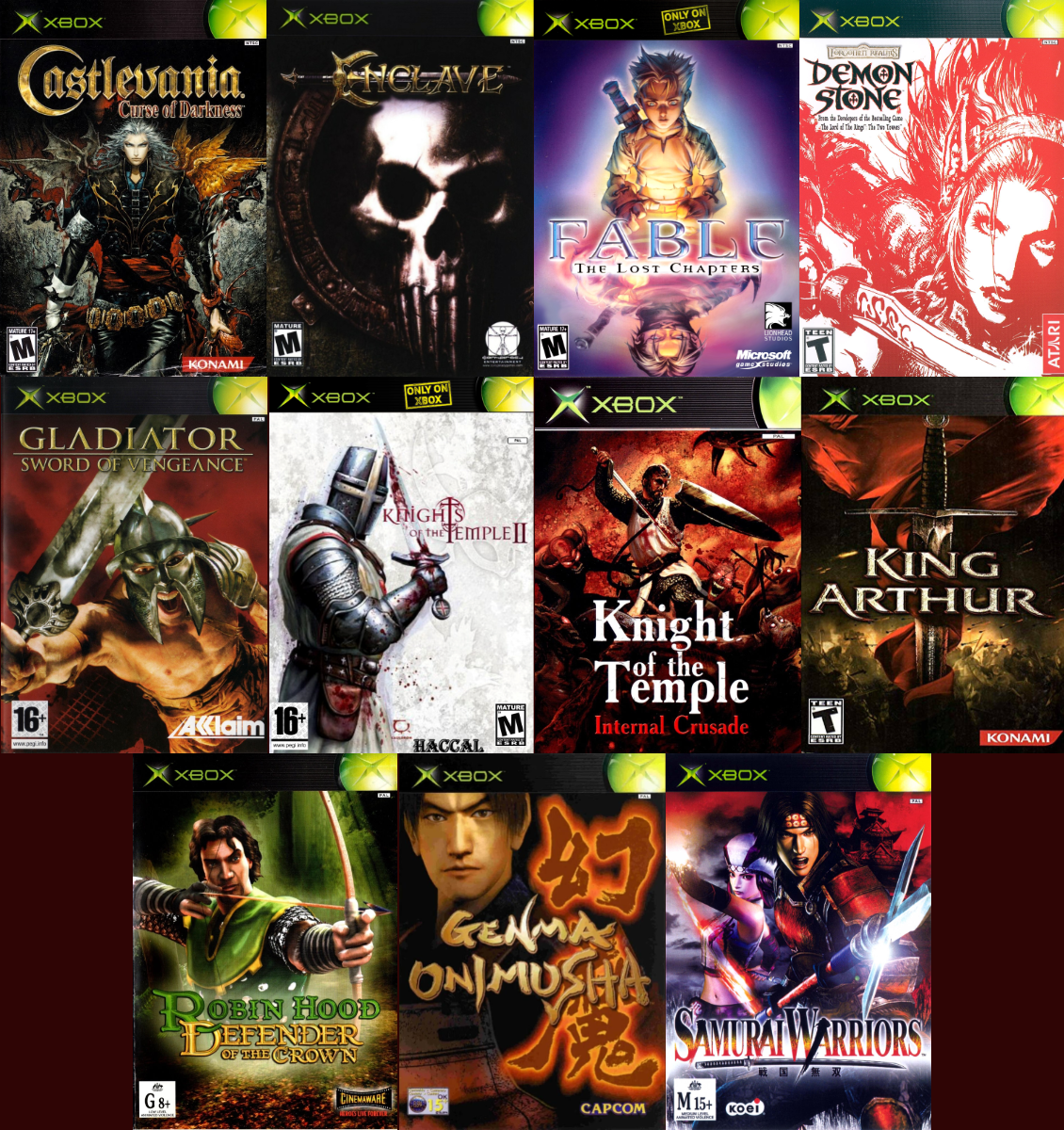
Enclave: Enclave is a third-person action game that combines medieval fantasy with intense sword-and-sorcery combat. Players choose between the forces of Light and Darkness, undertaking missions across a variety of environments filled with knights, archers, monsters, and powerful bosses. The combat system offers a satisfying selection of melee weapons, ranged attacks, and magical abilities, while the two campaigns provide different perspectives on the conflict. Its detailed environments, atmospheric soundtrack, and impressive visual presentation make the game stand out on the original Xbox. Although the controls can occasionally feel stiff and the mission structure is somewhat repetitive, Enclave delivers an engaging fantasy adventure for players who enjoy challenging combat and classic medieval settings.
Fable The Lost Chapters: Fable The Lost Chapters is an expanded version of the original Fable, offering an entertaining action RPG set in the fantasy kingdom of Albion. Players begin as a young hero and develop their character through quests, combat, exploration, and decisions that influence how others perceive them. The game features an accessible combat system built around melee weapons, ranged attacks, and magic, while its morality system allows the protagonist to become either a celebrated champion or a feared villain. The expanded edition introduces additional quests, locations, enemies, and story content, giving players more reasons to explore its charming world. Although the game is relatively compact by modern RPG standards, its humor, memorable characters, and freedom of choice make it one of the original Xbox’s most enjoyable fantasy adventures.
Knights of the Temple Infernal Crusade: Knights of the Temple Infernal Crusade is a third-person action game that places players in the role of a medieval Templar knight battling evil forces during a supernatural interpretation of the Crusades. Armed with swords, axes, maces, and other weapons, the protagonist fights through castles, villages, and dangerous landscapes while confronting human enemies and demonic creatures. The combat emphasizes direct melee encounters, with blocking, dodging, and different attacks playing important roles in survival. Its medieval architecture, religious imagery, and dark atmosphere help establish an appropriate setting for the adventure. However, repetitive encounters, limited exploration, and occasionally awkward combat mechanics prevent it from reaching the heights of the genre’s best offerings. Nevertheless, it remains an appealing choice for players seeking a straightforward medieval action game on the original Xbox.
Knights of the Temple II: Knights of the Temple II expands upon its predecessor with a more open-ended medieval adventure featuring exploration, quests, trading, and combat against human and supernatural enemies. Players once again assume the role of a Templar knight, traveling through a troubled medieval world while pursuing a larger mission involving dark forces. The game introduces a broader structure than the original, allowing players to visit different locations, acquire equipment, and complete optional tasks alongside the main storyline. Sword fighting remains central to the experience, supported by an assortment of weapons and armor. Although its environments and combat lack the polish of more prominent action games, the increased freedom gives the adventure a distinctive character. Knights of the Temple II is best suited to players who appreciate medieval action games with light role-playing elements and a mixture of combat and exploration.
Robin Hood Defender of the Crown: Robin Hood Defender of the Crown brings the legendary English outlaw into a medieval adventure centered on reclaiming England from oppressive rulers. Combining strategy, action sequences, and elements of territory management, the game challenges players to support the rebellion, defeat enemy forces, and strengthen Robin Hood’s position. Depending on the version and gameplay mode, the experience includes activities associated with the familiar legend, such as archery, sword fighting, and confrontations with rival nobles. Its historical fantasy setting, castles, and recognizable characters give it a classic medieval atmosphere. However, the presentation and gameplay are relatively simple compared with more ambitious action-adventure games, and the variety of activities does not always translate into consistently engaging play. It is primarily worth considering for players interested in Robin Hood adaptations and medieval-themed adventures rather than deep combat mechanics.
King Arthur: King Arthur is an action-adventure inspired by the legends of King Arthur and the Knights of the Round Table, placing players in a world of medieval warfare, legendary heroes, and supernatural dangers. The game focuses on third-person combat, allowing players to use medieval weapons while progressing through encounters and story-driven challenges. Its Arthurian theme provides an appealing backdrop of knights, castles, and mythical elements, making it a natural fit for fans of medieval fantasy. The emphasis on direct action keeps the gameplay accessible, although the combat and mission design can become repetitive, and the overall presentation lacks the depth of more accomplished Xbox adventures. Despite these shortcomings, King Arthur offers an opportunity to experience a familiar medieval legend through an action-oriented format, particularly for players who enjoy sword-based combat and fantasy interpretations of European history.
Gladiator Sword of Vengeance: Gladiator Sword of Vengeance is a third-person action game inspired by ancient Rome, casting players as a gladiator fighting against a corrupt empire and supernatural enemies. Although its setting belongs to antiquity rather than the Middle Ages, its arena combat, bladed weapons, and brutal battles may appeal to fans of historical action games. Players battle groups of opponents using sword attacks, combinations, special moves, and powerful finishing techniques while progressing through a series of increasingly challenging encounters. The game emphasizes fast-paced combat and a dark, stylized interpretation of Roman mythology, with impressive character animations and atmospheric environments helping establish its identity. Repetition and occasional camera or control frustrations can undermine the experience, but the satisfying combat and distinctive ancient-world setting make it an entertaining option for players who enjoy action games built around melee fighting.
Forgotten Realms: Demon Stone: Forgotten Realms: Demon Stone is a fantasy action-adventure set in the Dungeons & Dragons universe, following three unlikely heroes who must confront a dangerous supernatural threat. Players can switch between a fighter, a rogue, and a sorcerer, each offering distinct combat abilities and approaches to overcoming obstacles. The fighter excels in close combat, the rogue specializes in agility and stealth, and the sorcerer provides powerful magical attacks. This character-switching system adds variety to battles, while the cinematic presentation, recognizable fantasy creatures, and story-driven missions create the atmosphere of an interactive fantasy epic. Although the gameplay is relatively linear and some encounters become repetitive, the combination of three playable characters and a richly imagined fantasy setting makes Demon Stone an enjoyable choice for fans of medieval-style action adventures and Dungeons & Dragons lore.
Castlevania Curse of Darkness: Castlevania Curse of Darkness is a third-person action-adventure set in 1479, combining medieval European architecture with gothic horror and supernatural mythology. Players control Hector, a former Devil Forgemaster who can create and develop magical companions known as Innocent Devils to assist him in combat and exploration. The game features extensive weapon variety, character progression, challenging enemies, and large environments ranging from ruined castles to gloomy forests. Its crafting system and companion development provide more depth than a straightforward action game, while the dark soundtrack and gothic visual design reinforce the atmosphere. Some environments can feel repetitive, and the combat occasionally lacks precision, but the range of weapons, customizable companions, and elaborate boss battles make Curse of Darkness a rewarding experience for players who enjoy medieval horror and action RPG mechanics.
Genma Onimusha: Genma Onimusha is an enhanced version of the original Onimusha: Warlords, combining third-person action, samurai combat, and supernatural horror in a dark interpretation of feudal Japan. Players control Samanosuke Akechi, a warrior who battles demonic creatures while attempting to rescue Princess Yuki from the forces of Nobunaga Oda. Sword fighting, magical attacks, puzzle solving, and exploration form the core of the experience, while the collection of souls allows players to strengthen their weapons and abilities. The Xbox version introduces additional enemies, new gameplay challenges, and other changes that make the adventure more demanding than its PlayStation 2 counterpart. Its atmospheric environments, cinematic storytelling, and satisfying combat remain major strengths, although fixed camera angles and occasional backtracking reflect its early-2000s design. Genma Onimusha is an excellent choice for players who enjoy samurai action with a strong supernatural element.
Samurai Warriors: Samurai Warriors is a historical action game set during Japan’s Sengoku period, a time of rival warlords, shifting alliances, and large-scale military conflicts. Developed by Omega Force, the game adapts the battlefield formula of the Dynasty Warriors series, allowing players to control famous samurai and historical figures as they fight through armies of enemy soldiers. Each character has distinct weapons, combat techniques, and story scenarios, while battlefield objectives and encounters with rival commanders add structure to the action. The game captures the spectacle of historical warfare through enormous enemy formations and fast-paced combat, although repeated attacks and similar encounters can become monotonous over time. Its focus on Japanese history, recognizable warriors, and large battles makes it an appealing choice for fans of historical hack-and-slash games, even if it is less concerned with realistic military simulation than with dramatic action.
————————————————————————————–
Enclave
Enclave delivers a dark fantasy action-adventure experience defined by its tough, methodical combat and rewarding dual-campaign structure. Players can fight for either the forces of Light or the Dark, unlocking a diverse roster of characters—from heavily armored knights to agile archers and spell-casting mages—each offering distinct playstyles and weapon loadouts. On the original Xbox, it stood out with impressive visual design, rich environment art, and a challenging level-based structure that rewards careful positioning and resource management. While the rigid movement and demanding difficulty curve can feel punishing, its satisfying progression and immersive atmosphere make it a memorable gems for action RPG enthusiasts.
Fable: The Lost Chapters
Fable: The Lost Chapters expands Peter Molyneux’s iconic action-RPG into the definitive fantasy experience on the original Xbox, enriching the core game with expanded storylines, new regions, added spells, and deeper customization. The game excels at allowing players to shape their hero’s reputation and physical appearance through moral choices, turning actions into visible traits like glowing halos or sinister horns. Combining accessible real-time combat—blending melee, archery, and Will magic—with a charmingly whimsical British tone, it creates an unforgettable world that feels responsive to the player’s presence. While its world is fragmented into smaller hub zones rather than a true open realm, its personality, humor, and player agency remain unmatched on the console.
Knights of the Temple: Infernal Crusade
Knights of the Temple: Infernal Crusade is a gritty, heavy-hitting hack-and-slash adventure that puts players in the armor of Paul, a Templar Knight fighting through medieval Europe and the Holy Land to prevent a demonic breach. The combat emphasizes deliberate, weighty swordplay with a strong focus on parrying, combos, and divine special abilities, giving encounters a grounded sense of impact. Powered by crisp visuals and a oppressive, atmospheric soundtrack, the linear campaign delivers a satisfyingly dark medieval tone. Though the gameplay loop remains strictly focused on combat with minimal puzzle variety, its solid mechanics and intense pacing make it a treat for fans of dark medieval action.
Knights of the Temple II
Knights of the Temple II builds upon its predecessor’s foundation by shifting from a linear brawler into a more open, action-RPG-inspired adventure across vibrant Mediterranean ports and ominous ruins. Featuring a branching narrative structure with multiple endings, non-linear quest progression, and upgraded combo mechanics, the sequel offers significantly more depth and replay value. The weighted combat system returns with improved fluid movements and RPG progression elements, allowing players to upgrade Paul’s gear and holy powers as he searches for ancient relics. While some voice acting and pacing elements can feel unpolished, its broader scope and exploratory freedom make it a notable step forward for the series.
Robin Hood: Defender of the Crown
Robin Hood: Defender of the Crown breathes new life into Cinemaware’s classic strategy-adventure formula by blending tactical conquest with hands-on action minigames. Players take control of Robin Hood as he attempts to unite England by capturing territories on an overworld map, funding his campaign through archery ambushes, castle sieges using catapults, and grand jousting tournaments. The game transitions smoothly into third-person sword-fighting sequences during castle raids or rescue missions, giving players direct control over the hero. While the variety of gameplay styles means individual mechanics lack deep complexity, its vibrant presentation and satisfying loop of strategic expansion make it a unique strategy-action hybrid.
King Arthur
Based on the 2004 feature film, King Arthur is a surprisingly solid, cinematic hack-and-slash title that captures the gritty aesthetic of the movie. Players can take command of Arthur and his Knights of the Round Table—including Lancelot, Guinevere, and Tristan—each featuring unique weapon combos, archery abilities, and skill trees. The game stands out by smoothly integrating mounted horseback combat alongside traditional ground battles, matching the film’s chaotic, large-scale skirmishes. Although the combat loop can become repetitive during longer play sessions, its satisfying weight, cooperative campaign mode, and seamless movie transitions make it one of the better film adaptations on the system.
Gladiator: Sword of Vengeance
Gladiator: Sword of Vengeance is a visceral, bloody hack-and-slash action title that immerses players in the brutal arenas of ancient Rome. Playing as the fallen gladiator Thrax, players fight through the underworld and earthly arenas to overthrow an evil emperor, utilizing an array of gory executions, decapitations, and god-given magic abilities. The combat system focuses heavily on combo chains and arena hazards, rewarding stylish, aggressive play with blood-fueled upgrades. Although its camera angles can occasionally prove frustrating and the level design stays strictly linear, its sheer theatrical violence and satisfying melee mechanics deliver pure arcade-style thrills.
Forgotten Realms: Demon Stone
Forgotten Realms: Demon Stone is a fast-paced, high-fantasy hack-and-slash game set within the iconic Dungeons & Dragons universe, featuring a story penned by fantasy author R.A. Salvatore. Players seamlessly swap on the fly between three distinct heroes—a fighter, a rogue, and a sorcerer—to tackle massive waves of enemies, utilizing environmental traps, stealth kills, and devastating spell combos. The original Xbox version showcases impressive cinematic presentation, fluid character swapping, and voice work from actors like Patrick Stewart and Michael Clarke Duncan. While the campaign is relatively short and linear, its non-stop action and polished mechanics make it a standout for fans of isometric or third-person brawlers.
Castlevania: Curse of Darkness
Castlevania: Curse of Darkness offers a unique 3D spin on the beloved franchise by shifting focus away from the Belmont lineage to Hector, a Devil Forgemaster seeking vengeance against Dracula’s forces. The game’s defining feature is its Innocent Devil system, which lets players craft, evolve, and customize demonic companions that assist in battle, solve environmental puzzles, and provide passive stat buffs. Combined with an extensive weapon-crafting mechanics and deep combo systems, it offers a high degree of RPG customization and gameplay depth. Though its 3D corridor environments can feel somewhat sparse and repetitive compared to its 2D predecessors, its rich soundtrack, deep progression systems, and engaging combat make it a cult favorite.
Genma Onimusha
Genma Onimusha serves as the definitive, upgraded version of Capcom’s samurai survival-horror classic, taking full advantage of the original Xbox hardware. Retaining the core swordplay, puzzle-solving, and fixed-camera aesthetic of classic Resident Evil titles, this edition introduces a dangerous new green soul mechanic, deadlier enemy AI, and a powerful new boss enemy that dynamically hunts the player. The addition of enhanced lighting, altered item placements, and new armor upgrades provides a much more intense, strategic challenge than the PS2 original. It stands out as an outstanding blend of samurai action and survival horror, offering tight mechanics and a tense, rewarding atmosphere.
Samurai Warriors
Samurai Warriors translates Koei’s signature tactical crowd-clearing action into Sengoku-era Japan, offering a fresh historical spin on the established Musou formula. Players select from legendary historical figures, fighting through sprawling battlefields packed with hundreds of soldiers while completing dynamic, mid-battle objectives that influence the flow of combat. The game sets itself apart from its Dynasty Warriors siblings by introducing branching story paths, unique character skill trees, and a tension-filled tactical dodge mechanic. While the repetitive button-mashing gameplay won’t appeal to everyone, its deep roster, rich historical setting, and addictive character progression make it a highly enjoyable brawler.
——————————————————————————————-
Enclave
A rough, ambitious launch-window third-person action RPG from Starbreeze that feels like a medieval tech demo that somehow became a full game. You pick Light or Dark campaigns and a different archetype each mission – Knight, Huntress, Wizard, Berserker, Goblin – and hack through linear levels with swords, bows and magic. Combat is clunky by modern standards, no lock-on, brutal difficulty spikes, but the atmosphere, the soundtrack, and the sheer gothic scale of Celenheim still work. It’s short, punishing, and absolutely Xbox Original.
Fable: The Lost Chapters
The definitive Xbox medieval fantasy RPG and still the best version of Lionhead’s promise. Albion feels lived-in, British, and properly medieval – chicken-kicking villages, bandit camps, plate armor and longbows, not guns. The morality system is simple but satisfying, the combat is loose third-person melee with flourishes and Will magic, and the writing is wry and dark in a way later Fables lost. The Lost Chapters adds extra quests and a proper ending. It shows its age in camera and side-quests, but no other original Xbox game captures that King Arthur meets Monty Python fantasy better.
Knights of the Temple: Infernal Crusade
Starbreeze’s second medieval Xbox game after Enclave, and a straight European budget take on the Crusades with demons thrown in. You are a Templar fighting through monasteries, villages and hellish caverns in pure third-person hack-and-slash, with light/heavy attacks, holy powers, and a surprisingly good Within Temptation soundtrack. It’s short, repetitive, and was EU-only on Xbox, but the sword feel is heavy and the level design is better than it had any right to be. A hidden gem if you like Enclave’s vibe.
Knights of the Temple 2
This one never actually came to original Xbox – it was PC only in Europe in 2005 – but as a follow-up it swaps the first game’s focused brawler combat for a more open, buggy action-RPG. You play the same Templar twenty years later trying to save his daughter, now with dialogue choices, side quests, and a bigger world. Ambition outran execution, combat became floaty, AI is broken, and it loses the grim charm of the first. Worth playing only as a curiosity after you finish Infernal Crusade.
Robin Hood: Defender of the Crown
A remake of the 1986 classic that tries to cram five medieval games into one. Third-person floating camera, but gameplay jumps between real-time strategy on the map of England, one-on-one jousting, third-person sword duels, first-person archery from a castle tower, and siege catapult stages. None of them are deep, all of them are charming, and the presentation with full voice acting was lavish for 2003. It is shallow and gets repetitive fast, but as a light medieval sampler of what a Robin Hood legend should feel like, it still works.
King Arthur
The 2004 movie tie-in from Konami, and better than any movie tie-in had a right to be. You get five playable heroes including Arthur, Lancelot and Guinevere, each with slightly different combat styles, fighting through linear third-person levels ripped directly from the film’s battlefields – Hadrian’s Wall, Iceni forest, Badon Hill. Sword combat is basic combo work, archery and horseback sections break it up, and movie clips tie it together. It looks and sounds like a mid-2000s B-movie game, short and rough, but for Arthurian purists it’s the only original Xbox game that lets you live that specific gritty, post-Roman Britain version.
Gladiator: Sword of Vengeance
Acclaim Manchester’s ultra-violent revenge fantasy that starts in Rome but ends up feeling like a medieval hell-dungeon crawler. You are Invictus, a gladiator brought back from Elysium by the gods to punish Rome, carving through waves of undead legionaries and demons with swords, axes and spears in pure third-person arena combat. No exploration, just combat arenas with a combo system and brutal finishing moves. Controls are stiff, camera struggles, but the gore system was ahead of its time and the combat has weight. Short, bloody, and perfectly suited to a Sunday afternoon on a CRT.
Forgotten Realms: Demon Stone
The D&D action-RPG that wanted to be Lord of the Rings on Xbox. You control a party of three – fighter Rannek, sorcerer Illius, and rogue Zhai – swapping between them on the fly in third-person to solve light puzzles and fight hordes in Faerûn. Written by R.A. Salvatore with Patrick Stewart narrating, the story and voice acting punch far above the gameplay, which is simple hack-and-slash with some nice team-up moves. Environments are straight medieval fantasy – castles, Underdark, icy wastes. It’s repetitive and too short at 6 hours, but as a co-op couch brawler in a D&D skin, it’s one of the most polished medieval games on the system.
Castlevania: Curse of Darkness
A true third-person medieval gothic action-RPG and a direct sequel to Castlevania III. You play Hector, a Devil Forgemaster betrayed by Dracula, crafting Innocent Devils as living weapons to fight through a sprawling 15th century European castle and countryside. The combat system is deep for 2005, with dozens of weapon types and a surprisingly good crafting loop, but level design is infamous for empty, copy-paste corridors. Atmosphere, Michiru Yamane’s score, and the tragic medieval setting save it. Flawed, ambitious, and still the only 3D Castlevania on original Xbox.
Genma Onimusha
The Xbox-exclusive director’s cut of Onimusha: Warlords and a massive upgrade. Feudal Japan 1582, samurai Samanosuke Akechi fighting Nobunaga’s demon Genma army – so not European medieval, but the same era. Fixed camera third-person survival-action with magic swords absorbing souls, now with new areas, new boss, improved textures, 5.1 audio and even green blood to reduce censorship. Combat is deliberate and tense, more samurai horror than musou. It looks better than most early Xbox games and plays like Capcom at their most confident. Essential if you like Onimusha at all.
Samurai Warriors
Koei’s original musou take on Sengoku Japan, a more tactical, grounded ancestor to Dynasty Warriors. You pick one of 15 samurai officers and cut through hundreds of soldiers in third-person battlefields set across historical Japanese provinces. On Xbox it runs smoother than PS2, with more enemies on screen and better draw distance, but the core loop is pure Koei: light and heavy attacks, musou specials, capturing forts. Story mode is simple history lessons with a dramatic twist. Repetitive by design, but if you want that medieval Japanese warfare fantasy of being a lone warrior changing a battle, this is where the series started.
——————————————————————————————-
Enclave is a third-person action RPG set in a medieval fantasy realm that lets you experience the story from two distinct perspectives, fighting as either a Warrior of Light or a Minion of Darkness. Its combat is solid and the dual campaign structure adds replay value, though the game is perhaps most remembered for its stunning visuals, which were among the best on the original Xbox. The difficulty can be punishing at times, but for fans of the genre looking for a challenging medieval adventure, Enclave delivers a satisfying experience with a dark, atmospheric world to explore.
Fable The Lost Chapters is an expanded version of the original Fable, a beloved action RPG set in the medieval fantasy land of Albion where your choices shape your character’s appearance, abilities, and reputation. The Lost Chapters version adds new quests, areas, weapons, and monsters to the base game, making it the definitive way to experience this classic. Its charming British humor, moral decision-making, and accessible combat system make it one of the most memorable RPGs on the original Xbox, even if its ambitious promises were not entirely fulfilled.
Knights of the Temple Infernal Crusade is a medieval hack-and-slash action game where you play as a Templar knight on a quest to rescue a kidnapped princess from the forces of darkness. The combat is straightforward and brutal, with a variety of weapons and finishing moves, but the game is often criticized for its repetitive level design and clunky controls. It offers a decent dose of medieval combat for fans of the genre, though it lacks the polish and depth of better-known titles in the same category.
Knights of the Temple 2 continues the story of the Templar knight, this time battling against the forces of hell in a more open-ended medieval setting. The sequel improves upon its predecessor with better combat mechanics and more varied environments, but it still struggles with technical issues and a lack of narrative depth. It is a serviceable action game for those craving more medieval hacking and slashing, but it remains a fairly forgettable entry in the Xbox library.
Robin Hood Defender of the Crown is a medieval action-adventure game that puts you in the shoes of the legendary outlaw Robin Hood as he fights to free England from the tyrannical Prince John. The game mixes sword fighting, archery, and stealth mechanics across a series of missions, and it features a story that loosely follows the classic legend. While it has its moments, the gameplay can feel stiff and the presentation is dated, making it a title best suited for die-hard fans of the Robin Hood mythos.
King Arthur is a medieval action-adventure game based on the legendary king and his Knights of the Round Table, featuring a story-driven campaign with sword combat and magical abilities. The game attempts to blend cinematic storytelling with hack-and-slash gameplay, but it was met with mixed reviews due to its repetitive combat and lackluster graphics. It offers a playable but ultimately unremarkable take on the Arthurian legend for the original Xbox.
Gladiator Sword of Vengeance is a brutal action game set in ancient Rome where you play as a gladiator seeking revenge against a corrupt empire. The combat is fast and violent, with a variety of weapons and arena battles, and the game features a dark, gritty atmosphere that captures the brutality of gladiatorial combat. It is a solid but somewhat shallow experience that will appeal to fans of historical action games looking for a quick, bloody fix.
Forgotten Realms Demon Stone is a Dungeons & Dragons action RPG set in the medieval fantasy world of Faerûn, featuring three playable characters with unique abilities who must work together to stop a demonic invasion. The game was co-written by R.A. Salvatore and features voice acting by Patrick Stewart, giving it a strong narrative pedigree. Its combat is enjoyable and the character-switching mechanic adds depth, making it one of the better D&D action games on the original Xbox.
Castlevania Curse of Darkness is a dark fantasy action game set in a medieval European-inspired world where you play as Hector, a Devil Forgemaster seeking revenge against Dracula. The game features deep crafting mechanics for creating weapons and demon allies, and its combat is more tactical than typical hack-and-slash games. While it may not reach the heights of the best Castlevania titles, it offers a lengthy and engaging adventure for fans of the series and gothic medieval settings.
Genma Onimusha is an enhanced version of the original Onimusha Warlords, a survival horror action game set in a fictionalized medieval Japan where you play as a samurai battling demons with a magical gauntlet. The Genma version adds new enemies, areas, and gameplay tweaks, making it the most complete version of the game. Its blend of sword combat, puzzle solving, and eerie atmosphere makes it a standout title for fans of samurai and supernatural action.
Samurai Warriors is a hack-and-slash action game set in feudal Japan that puts you in control of various historical samurai and ninja as they battle through massive armies on the battlefield. The game is part of the Warriors franchise and features the signature over-the-top combat and large-scale battles the series is known for. While it lacks the historical depth some might expect, it delivers satisfying action and plenty of content for fans of the genre.