WCW Backstage Assault
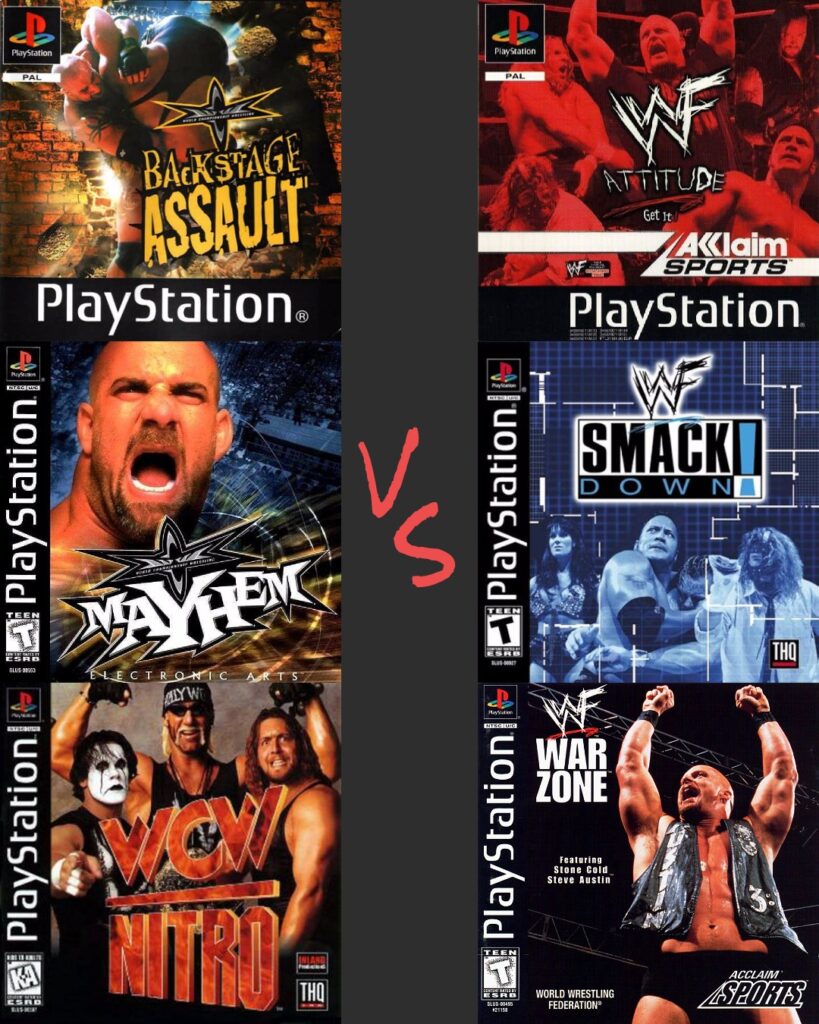
Released in 2000, this title is one of the most polarizing experiments in wrestling game history because it features no wrestling ring. Every match takes place in environments like parking lots, loading docks, and boiler rooms, emphasizing “hardcore” brawl mechanics over traditional technical wrestling. While the concept of a dedicated backstage fighter was unique, the blocky character models, clunky collision detection, and repetitive “swing-and-miss” combat made it a frustrating finale for the WCW brand on the PlayStation.
WCW Backstage Assault tried to stand out from other wrestling games by removing the traditional ring entirely and placing every match in backstage areas like parking lots, locker rooms, and production rooms. While this concept sounded fresh, the execution felt limited because the environments were repetitive and the gameplay mechanics were extremely simple. The controls are basic and somewhat stiff, offering fewer moves and less depth than most wrestling games of the era. Character models are recognizable but lack personality, and the overall presentation feels rushed. Although the backstage-only idea was unique, the lack of variety and shallow gameplay make Backstage Assault one of the weaker WCW titles on the PlayStation.
WCW Mayhem
WCW Mayhem was Electronic Arts’ high-energy debut with the license, famous for being the first game to allow players to seamlessly walk backstage during a match. It boasted an impressively crisp presentation for 1999, featuring authentic TV-style overlays and high-quality commentary from Tony Schiavone and Bobby “The Brain” Heenan. Though the gameplay was more “arcade-style” and less deep than its N64 rivals, its fluid animations and the massive star power of the nWo and Goldberg made it a standout title for WCW fans.
WCW Mayhem marked a step forward for WCW games on the PlayStation with improved graphics, a larger roster, and smoother gameplay compared to earlier titles. Wrestlers feature recognizable entrances and signature moves, giving the game a more authentic WCW feel. The controls are relatively easy to learn, focusing on fast-paced arcade-style wrestling rather than deep simulation. While the commentary and animations can become repetitive, the overall presentation captures the energy of WCW during its late-1990s peak. Though it lacks the polish and depth of some WWF competitors, Mayhem remains one of the better WCW wrestling experiences available on the PS1.
WCW Nitro
As a port of the PC and Saturn versions, WCW Nitro is a fast-paced, 1997 time capsule that feels more like a traditional fighting game than a wrestling simulator. It utilized a “dial-a-combo” system for moves and featured digitized FMV (full-motion video) rants from wrestlers like Hollywood Hogan and Sting on the selection screen, which added a great layer of “Monday Nitro” atmosphere. However, the gameplay was notoriously stiff and shallow, relying more on button-mashing than the strategic grappling found in later titles.
WCW Nitro is a flashy but simplistic wrestling game that emphasizes arcade-style action over realism. The game features colorful graphics, exaggerated character animations, and a large roster of WCW wrestlers from the late 1990s. Controls are easy to pick up, allowing players to quickly perform grapples and signature moves, but the gameplay becomes repetitive due to limited mechanics and shallow match structure. While the presentation captures the over-the-top style of WCW television, the lack of depth and repetitive commentary reduce long-term replay value. Still, for quick multiplayer matches with friends, Nitro offers some chaotic fun.
WWF Attitude
The 1999 sequel to War Zone, WWF Attitude is the definitive “Attitude Era” experience in terms of content, featuring a massive roster and a groundbreaking Create-a-Wrestler mode that set the standard for the industry. It retained the complex, “Mortal Kombat-style” button inputs for every move, which rewarded players who could memorize long sequences but alienated those looking for a pick-up-and-play experience. Despite the steep learning curve, its sheer volume of match types and gritty atmosphere perfectly captured the chaos of the late ’90s wrestling boom.
WWF Attitude attempted to expand on the foundation laid by WWF War Zone with a much larger roster, more match types, and deeper customization options. The game includes many wrestlers from the height of the Attitude Era, and its create-a-wrestler mode was quite ambitious for the time. However, the complex button combinations required to perform moves can make the gameplay feel awkward and difficult to learn. While the presentation successfully reflects the edgy tone of WWF programming in the late 1990s, the stiff animations and complicated controls prevent the game from reaching its full potential.
WWF SmackDown! 2: Know Your Role
Widely considered the greatest wrestling game on the PS1, this 2000 masterpiece by Yuke’s replaced the clunky combo systems of previous games with a lightning-fast “quick grapple” mechanic. It introduced an incredibly addictive, branching Season Mode that allowed players to live through the weekly drama of Raw and SmackDown, complete with run-ins and backstage segments. With its massive roster, introduction of TLC (Tables, Ladders, and Chairs) matches, and snappy controls, it remains highly playable even by modern standards.
WWF SmackDown! 2: Know Your Role is widely regarded as one of the best wrestling games on the original PlayStation thanks to its fast gameplay, massive roster, and impressive number of match types. The controls are simple and responsive, making matches feel energetic and accessible compared to the slower, more complicated systems used in earlier WWF titles. Its season mode offers surprising depth, with branching storylines and unexpected events that add replay value. Although the graphics show their age and the frame rate can dip with many characters on screen, the overall package delivers an exciting and highly replayable wrestling experience.
WWF War Zone
WWF War Zone was a technical marvel in 1998, bringing the WWF into the world of full 3D graphics with impressive muscle definition and motion-captured taunts. It was the first game to truly capture the “theatrics” of the product, including voiced entrance themes and interactive crowds that would chant for specific wrestlers. While the gameplay was criticized for being slow and requiring complex fighting-game inputs to perform basic slams, its success proved that there was a massive market for high-fidelity wrestling simulations on home consoles.
WWF War Zone was one of the first major WWF wrestling games on the PlayStation and helped establish a new direction for wrestling titles at the time. The game features detailed character models and authentic entrance sequences that were impressive when it was released. However, the control system relies heavily on complex button combinations, making it difficult for new players to perform moves consistently. While the roster is relatively small and the gameplay can feel stiff compared to later titles, War Zone still deserves recognition for laying the groundwork that future WWF games would build upon.
WCW games, WWF games, wrestling games, PS1 game reviews