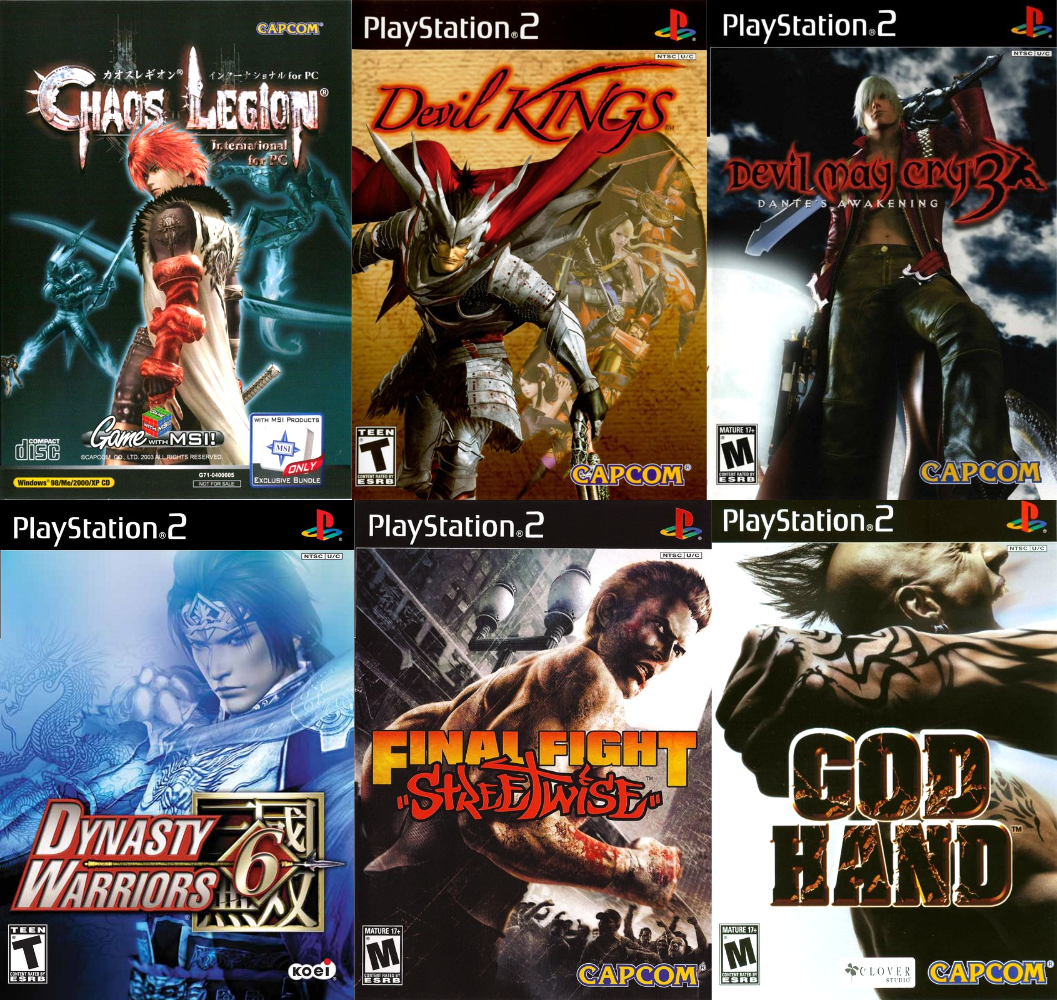
God Hand: God Hand is one of the most distinctive and brutally entertaining action games on the PS2, combining over-the-top martial arts with absurd humor and an incredible amount of combat freedom. Its customizable fighting system lets you build your own moveset from a huge selection of punches, kicks, throws and special attacks, making every encounter feel personal. The difficulty can be unforgiving, but mastering enemy patterns and learning to exploit your arsenal is extremely satisfying. The visuals are fairly simple compared with other action games of its era, yet the exaggerated animations and energetic presentation give it plenty of personality. God Hand is chaotic, challenging and wonderfully unconventional, making it a cult classic that deserves far more recognition.
Final Fight Streetwise: Final Fight: Streetwise attempts to bring Capcom’s classic beat-’em-up series into the 3D era, following Cody’s brother Kyle through a gritty Metro City filled with gangs, drug dealers and bizarre underground characters. The game combines traditional brawling with exploration, driving, weapon use and a surprisingly large selection of combat moves, although the controls and camera can sometimes make fights frustrating. Its dark, grimy atmosphere is a major departure from the colorful arcade originals, and the story has an unusual mix of serious crime drama and exaggerated comic-book action. The graphics are serviceable but dated, while the repetitive missions and occasional technical problems prevent it from reaching the heights of the best PS2 beat-’em-ups. Still, Streetwise is an interesting curiosity for Final Fight fans and offers some enjoyable old-school street fighting.
Dynasty Warriors 6: Dynasty Warriors 6 delivers the familiar Musou formula of charging across enormous battlefields while cutting through seemingly endless waves of enemy soldiers, but it introduces several changes that distinguish it from earlier entries. The new Renbu combat system encourages continuous attacks and creates spectacular chains of strikes, while the large battlefields and huge enemy counts provide the series’ trademark sense of scale. Unfortunately, the game feels somewhat stripped down compared with Dynasty Warriors 5, with fewer characters, weapons and modes, and its visual presentation is only a modest improvement. The repetitive objectives can also become tiring after extended sessions. Nevertheless, the satisfying combat, dramatic historical atmosphere and sheer spectacle of fighting hundreds of enemies at once still make Dynasty Warriors 6 an enjoyable Musou experience.
Devil May Cry 3: Devil May Cry 3 is arguably one of the finest pure action games on the PS2, combining fast, technical combat with an excellent style system that allows players to specialize in different approaches to battle. Dante’s multiple weapons and fighting styles provide enormous variety, while the challenging enemies and bosses demand timing, reflexes and mastery of the combat system. The game also features a much stronger story than its predecessor, focusing on Dante and Vergil while delivering memorable characters and stylish cutscenes. Its gothic environments, excellent soundtrack and spectacular action remain impressive, although the original release is notoriously difficult. With tremendous depth and exceptional replay value, Devil May Cry 3 remains a benchmark for character-action games.
Devil Kings: Known as Sengoku Basara in Japan, Devil Kings is Capcom’s energetic take on the Warriors-style action formula, replacing historical realism with exaggerated heroes, ridiculous attacks and spectacular battles against enormous armies. Each character has a distinctive moveset and personality, and the fast-paced combat encourages players to launch enemies into the air and tear through crowds with increasingly outrageous techniques. The presentation is colorful and stylish, with a strong anime-inspired atmosphere and an entertaining soundtrack. Compared with Dynasty Warriors, the game is less concerned with tactical battlefield management and more focused on pure arcade-style action. It may not offer the depth or scale of later Musou titles, but its exaggerated combat and colorful cast make Devil Kings an enjoyable and accessible alternative.
Chaos Legion: Chaos Legion is a stylish action game that combines Devil May Cry-inspired swordplay with a unique Legion system, allowing the player to summon supernatural warriors to fight alongside the protagonist, Sieg. Different Legion types provide offensive, defensive and tactical abilities, giving the combat a strategic element beyond simply attacking enemies with a sword. The gothic environments and dark fantasy setting create an appropriately dramatic atmosphere, while the soundtrack complements the game’s intense battles. Unfortunately, the level design can become repetitive, the camera occasionally causes problems, and the combat lacks the refinement of Devil May Cry. Even so, its Legion mechanic gives it a distinctive identity, and fans of dark fantasy action games may find plenty to enjoy in this underrated PS2 title.
——————————————–
God Hand Developed by Clover Studio and directed by Shinji Mikami, God Hand is a wildly energetic, third-person beat ’em up that trades cinematic polish for blistering, skill-based combat and unfiltered absurd humor. Playing as Gene, a fighter equipped with a god-like arm, players weave through punishing waves of bizarre enemies using a fully customizable combo system that lets you assign tailored martial arts moves to every face button. The game’s dynamic difficulty scales in real-time, rewarding flawless dodging and counter-attacks while relentlessly punishing mistakes, making it an unforgiving test of reflexes. Though polarising and misunderstood upon its initial 2006 release due to its steep learning curve and fixed camera angle, it has since attained cult-classic status as one of the most mechanically deep action titles on the PlayStation 2.
Final Fight Streetwise Capcom’s 2006 attempt to reboot its seminal arcade franchise into a dark, gritty 3D action-adventure largely misjudged what made the original iconic. Following Kyle Travers as he searches Metro City’s underground for his kidnapped brother Cody, Final Fight Streetwise trades vibrant beat-’em-up action for dreary urban environments, an excessively edgy narrative, and a repetitive combat system bogged down by clunky lock-in mechanics. While the inclusion of mini-games, weapon upgrades, and guest appearances from series veterans provides brief moments of nostalgia, the sluggish controls, uninspired mission design, and aggressive reliance on early-2000s angst prevent it from capturing the kinetic charm of its arcade predecessor.
Dynasty Warriors 6 Marking Koei’s ambitious transition into the next-gen era, the PlayStation 2 port of Dynasty Warriors 6 brought sweeping changes to the long-running Three Kingdoms hack-and-slash formula, though not without compromise. The headline addition was the Renbu system, a combo mechanic that replaced traditional button sequences with a continuous attack string that grew more devastating as players maintained uninterrupted offense. While the game featured overhauled character designs, revamped motion-captured movesets, and scenic battlefields, the PS2 version suffered from noticeable visual downgrades, frame-rate dips, and a reduced enemy count on screen compared to its Xbox 360 and PS3 counterparts, making it a divisive entry among series enthusiasts.
Devil May Cry 3: Dante’s Awakening A masterclass in hack-and-slash game design, Devil May Cry 3 revitalized the franchise by serving as a stylish prequel that introduces a younger, delightfully arrogant Dante clashing with his twin brother Vergil. The game overhauled 3D action combat with its revolutionary Style system—allowing players to choose between trickery, gunslinging, swordplay, or defense—which, combined with an extensive arsenal of unlockable weapons, offered unmatched combo freedom and mechanical depth. Infamous for its crushing difficulty curve in its original Western release, its rewarding skill ceiling, exhilarating boss fights, and rock-infused soundtrack solidified it as one of the definitive action experiences on the PlayStation 2.
Devil Kings Capcom’s Western localization of Sengoku Basara, released in 2005 as Devil Kings, attempted to adapt Japan’s feudal Sengoku period into a high-octane 3D action game similar to Dynasty Warriors, albeit with a heavily stylized dark-fantasy twist. Players hack through thousands of enemy soldiers using over-the-top special attacks, elemental abilities, and exaggerated character designs, ranging from dual-wielding pistol cowboys to massive armored giants. However, the Western release suffered from controversial localization changes, including altered character names, a stripped-out tactical map system, and artificially inflated difficulty, which dampened its tactical depth even as its fluid, arcade-style combat offered satisfying spectacle.
Chaos Legion Released by Capcom in 2003, Chaos Legion is a gothic action game that mixes traditional swordplay with tactical minion management. Playing as the knight Sieg Wahrheit, players navigate dark fantasy battlefields overrun by hordes of monstrous creatures, relying heavily on the ability to summon spectral warriors known as “Legions” to fight alongside them in real-time. Each Legion type—ranging from shield-bearing defenders to long-range archers—provides distinct offensive or defensive strategies, requiring players to balance Sieg’s movement with troop positioning. While its gloomy aesthetic, haunting orchestral soundtrack, and unique summoning mechanics gave it a distinct identity, rigid controls and repetitive level environments kept it from reaching the heights of its contemporary action stablemates.
———————————————
God Hand: Clover Studio’s final game before they closed, and it’s pure punk rock. You play as Gene, a guy with a godly arm punching his way through a ridiculous, racist, horny, deliberately offensive Mad Max-meets-Fist of the North Star world. The combat is brutally hard and incredibly deep – dodge, weave, duck, and customize your own combo strings with over 100 moves. It got trashed on release for its ugly visuals and mean difficulty, but it’s now considered one of the best and funniest 3D brawlers ever made on PS2.
Final Fight Streetwise: Capcom tried to bring Final Fight into the gritty PS2-era GTA world and it mostly didn’t work. You play as Kyle Travers, Cody’s younger brother, brawling through the streets to save Cody from a drug plot. It’s a clunky, repetitive 3D beat-em-up with stiff controls, a frustrating camera, and an instafail pit-fighting minigame. It has some charm if you love the series lore and the soundtrack by Slipknot’s Corey Taylor isn’t bad, but compared to God Hand which came out the same year, it feels cheap and unfinished.
Dynasty Warriors 6: The PS2 port of Dynasty Warriors 6 is the weakest way to play this entry. The PS3/360 version was already divisive for dropping clones and introducing the Renbu combo system and a lot of samey movesets, and the PS2 version cuts even more – less enemies on screen, worse graphics, less content, and heavy slowdown. If you’re a die-hard Warriors fan who only had a PS2, it was still mindless fun mowing down thousands of soldiers as Lu Bu, but it’s the definition of a compromised port.
Devil May Cry 3: The peak of stylish action on PS2. After the disappointing DMC2, Capcom went back and made the hardest, deepest, most stylish game in the series. Young, cocky Dante vs his brother Vergil, with a full Style system – Trickster, Swordmaster, Gunslinger, Royalguard – that completely changes how you fight. Insane boss fights, incredible combat depth, and a cheesy anime story that actually works. This is the Special Edition you want for Vergil as a playable character. Essential.
Devil Kings: This is actually Sengoku Basara in Japan, Capcom’s over-the-top take on their own Dynasty Warriors formula set in feudal Japan. Renamed and poorly localized for the West with generic fantasy names. You play as absurdly anime samurai warlords with giant swords and elemental superpowers slaughtering armies. It’s much faster, flashier, and more combo-driven than Dynasty Warriors of the same era, but it was ignored because of the bad westernization. A cult classic brawler.
Chaos Legion: Another Capcom oddity from 2003. You play as Sieg Warheit, a goth knight in black armor hunting his former friend Victor Delacroix. The gimmick is you don’t fight alone – you summon Legions, seven different types of demonic armies – sword, arrow, bomb, shield, etc. – to swarm enemies while you support them. It’s repetitive, dark, and has a very edgy early-2000s Devil May Cry vibe, but the Legion system is genuinely unique and the art direction and soundtrack are great. Flawed but memorable.
———————————————
God Hand
A gloriously unhinged and brutally difficult beat-’em-up, God Hand is the swan song of Clover Studio that remains a cult classic for its sheer audacity. While its visuals and camera work are rough and the environments are bland, the game’s ridiculously over-the-top presentation and deep, customizable combat system are its saving graces. Players can create their own combo strings by assigning a vast library of punches, kicks, and guard-breakers to face buttons, finding the perfect balance of speed and power. This, combined with a cast of bizarre enemies like Lucha Libre gorillas, a hilarious sense of humor, and a punishing difficulty that makes every victory feel earned, cements its reputation as one of the most unique and memorable action games on the PS2.
Final Fight Streetwise
A misguided attempt to modernize the classic brawler franchise, Final Fight Streetwise swaps the series’ arcade roots for a gritty, open-world setting heavily inspired by Grand Theft Auto. The story, which sees you controlling Cody’s brother Kyle as he searches for his kidnapped sibling, leads to a mix of uninspired fetch quests and mini-games that often feel more tedious than entertaining. Though the hand-to-hand combat has a solid foundation of “snappy” combos, the experience is hampered by technical issues, poor camera angles, and a generally unpolished presentation. While it has moments of cheesy charm and an interesting “Arcade mode,” the overall package is a deeply flawed title that fails to capture the magic of its predecessors.
Dynasty Warriors 6
A disappointing port of a subpar entry, Dynasty Warriors 6 on the PS2 strips the series down to its most mindless and repetitive elements while introducing severe technical problems. The new “Renbu” combat system simplifies the action to a single button, and the core loop of mowing down thousands of idle soldiers remains as shallow as ever. The PS2 version is a visual downgrade, suffering from frequent slowdown, atrocious pop-in where enemies appear and vanish feet away, and even had advertised features like swimming removed. While it does include six exclusive characters not seen in the other console versions and a skill tree for character progression, these additions are lost amid the poorly optimized, tedious gameplay.
Devil May Cry 3
A triumphant return to form, Devil May Cry 3 is a masterclass in stylish action that reignited the series’ legacy after a lackluster sequel. As a prequel, it explores Dante’s cocky origins and his rivalry with his twin brother Vergil, delivering a story that is both cool and genuinely compelling. The game’s combat is legendary for its depth and creativity, letting players select from four distinct “Styles” that radically change the gameplay, and seamlessly switch between multiple weapons mid-combo to achieve sky-high style rankings. Its brutal but fair difficulty, incredible gothic aesthetic, and blistering 60FPS framerate make it an essential action title that has aged better than almost any other game of its generation.
Devil Kings
As the North American localization of Sengoku Basara, Devil Kings aims to be Capcom’s hyper-stylized answer to the Dynasty Warriors formula, and it largely succeeds with its frantic, over-the-top combat. The game pits you against hordes of enemies in the service of conquering a map of feudal Japan, offering a roster of unique characters with flashy attacks and an emphasis on massive, screen-clearing special moves. However, its Western release is marred by an odd localization that strips the Japanese characters of their historical names for generic titles, and the gameplay, while exciting in bursts, can become repetitive. For fans of the genre looking for a faster, more bombastic alternative, it’s an interesting hidden gem, but its graphical glitches and lack of strategic depth prevent it from being a classic.
Chaos Legion
Often dismissed as a budget Devil May Cry clone, Chaos Legion offers a solid if uninspired action experience with its own unique hook: summonable demon allies. You play as Seig Warheit, a “poncily dressed” protagonist on a quest to stop a villain with a confusing plot involving resurrection. The core combat involves hacking through hordes of enemies, but the main innovation is building up points to summon a “Legion” of demons that can fight alongside you, a mechanic that becomes essential in the game’s later, brutally difficult stages. While it features detailed character models and a commendable soundtrack, the game is let down by repetitive button-mashing gameplay, bleak and cramped environments, and a short campaign that feels more like a time-killer than a must-play title.